

The Solid State Logic (SSL) SL 4000 E Series is one of the most significant analogue mixing consoles ever built. Introduced in 1979, it combined features that were unusual at the time: per-channel compression and gating, a four-band EQ (that was later updated to include design input from George Martin), flexible routing, and the now-famous bus compressor. Just as important were workflow advances like SSL’s “Total Recall,” which let engineers store and reload control settings from floppy disks. The console’s innovations and workflows shaped the way engineers approached recording and mixing through the 1980s and into the digital era.
Sir George Martin played a key role in shaping the SL 4000 E’s sound when AIR Studios commissioned its first SSL desk. His collaboration with SSL led directly to the development of the smoother, more flexible “Black Knob” ’242 EQ, introduced in 1983 and soon adopted across E-Series consoles.
My favourite piece of gear is an SSL Console… I’ve grown very accustomed to mixing on SSL consoles. I started with an E-Series.
Andy Wallace
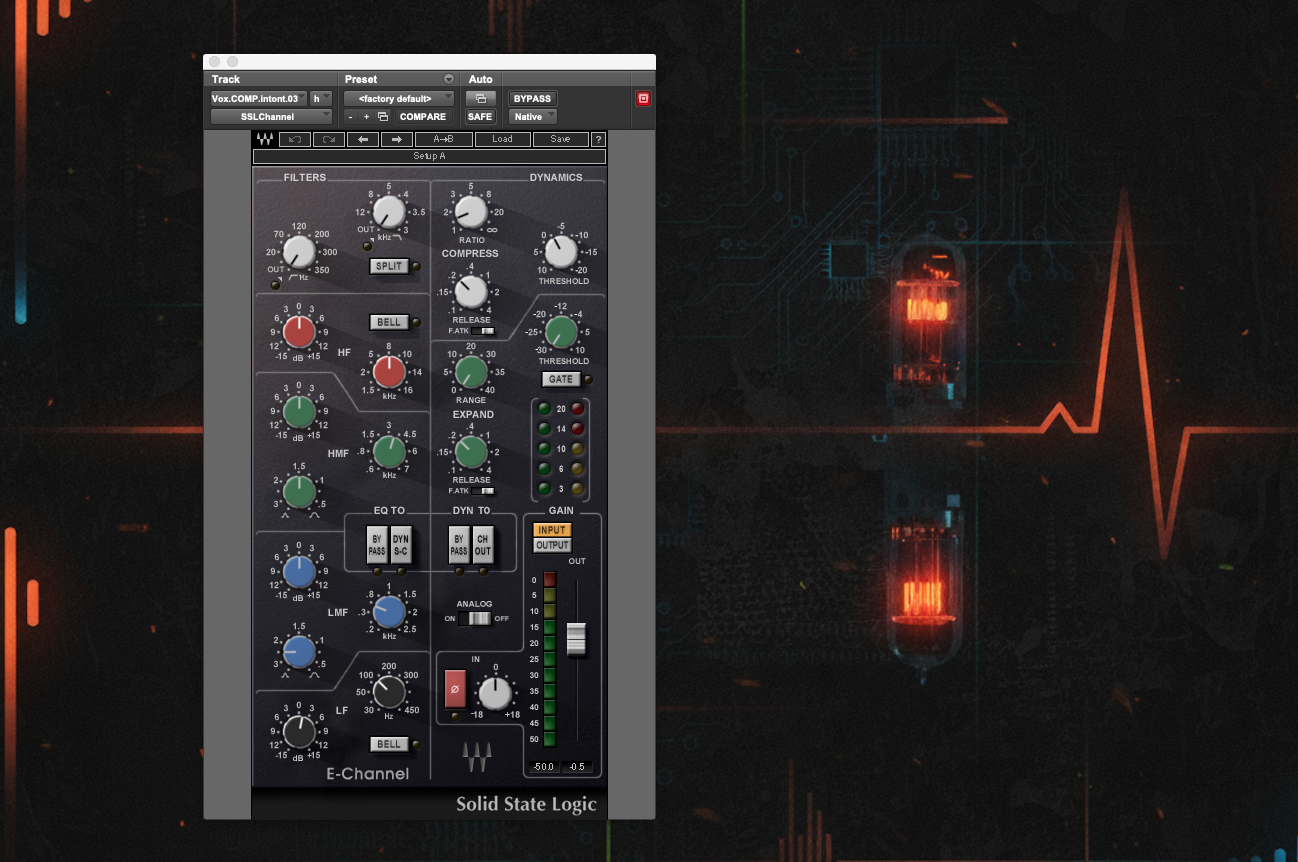
That reputation has made the 4000 E a popular target for software emulation. Waves’ SSL E-Channel, developed in collaboration with SSL, is one of the most widely used attempts to capture the console’s sound and workflow in plugin form. On paper, the plugin reproduces the same core building blocks: the channel EQ, filters, compressor, gate/expander, and the characteristic interaction between them, but what’s it like to work with?
SSL E-Channel Functionality and Control Sections
The original E-Series console used a fixed, inline signal path with EQ and dynamics controls stacked vertically in each channel strip. The plugin takes a different approach, placing dynamics and EQ side-by-side to help things fit on the screen more easily.
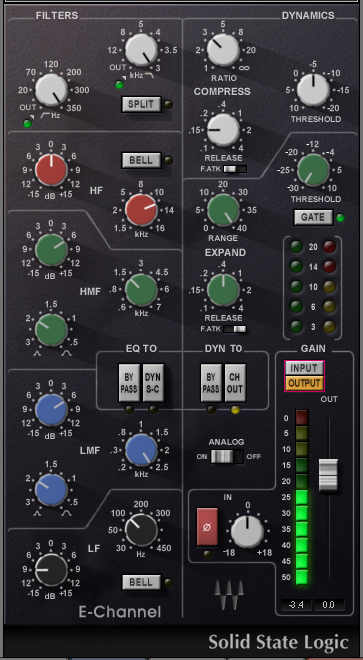
The Dynamics Section incorporates a compressor/limiter and an expander/gate. The compressor features a soft-knee characteristic, with a ratio range extending from 1:1 all the way up to ∞:1, for subtle compression through to hard limiting. Threshold adjustments are available from +10 dB to −20 dB. Attack times can be selected between an approximately 1ms “Fast” mode and a program-dependent “Slow” mode. Release times span from a snappy 0.1 to a super slow 4 seconds.
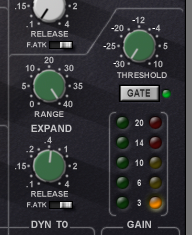
The expander/gate offers a threshold range of −30 dB to +10 dB, a depth range of 0 to 40 dB, and attack/release parameters similar to the compressor. A DYN TO routing option allows for the dynamics section’s placement either before (DYN TO CH OUT not selected) or after the EQ (DYN TO CH OUT engaged). Like the original hardware console, the plugin features automatic gain make-up of the compressor, adjusting output based on ratio and threshold settings.
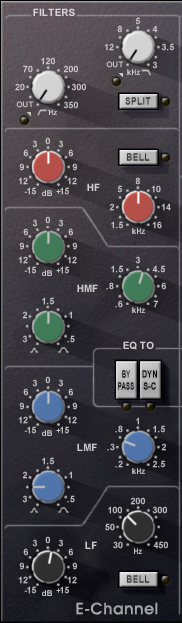
The EQ Section, modelled after the ‘”‘Black Knob'”‘ (242) four-band EQ, (SSL also made ‘Brown knob’ and ‘Orange knob’ versions of their EQs for the E series), includes High-Pass and Low-Pass switchable filters, (earlier versions of the hardware console were fitted with EQ modules which didn’t allow for the filters to be fully bypassed). It comprises four sweepable bands: High Frequency (HF), High Mid Frequency (HMF), Low Mid Frequency (LMF), and Low Frequency (LF). The HF and LF bands offer switchable modes between shelving and bell curves; the HMF and LMF bands provide adjustable Q controls; and the EQ section can be bypassed (separately from the HPF and LPF filters when the filter’s SPLIT switch is engaged) using the EQ TO BYPASS switch.
The filters’ SPLIT mode allows them to be placed pre-dynamics processing, and an EQ TO DYN S-C switch straps the full EQ section across the dynamics section’s sidechain input (compression detection circuit). Gain ranges, although marked as up to ±15 dB, vary with Q and curve shape to provide up to ±18 dB.
The Master Section contains controls for input trim (±18 dB), an output fader providing +12 to -24 dB of trim, a level meter configurable for either input or output monitoring, and a polarity inversion switch.
The real console’s sound came from various analogue “imperfections” – harmonic distortion, headroom limits, component tolerances, and inherent noise, especially when pushed hard. The plugin includes an Analog On/Off switch which engages or disengages modelling of these analogue circuitry characteristics.

Waves claims the plugin operates with just 1 sample of latency, which I’m happy to confirm.
As with all Waves plugins, the utility section at the top of the plugin window provides preset management, undo/redo functionality and the A/B comparison feature.
So how is the SSL E-Channel in use?
The SL 4000 E is renowned for giving drums an aggressive and punchy character but it also helped define the sound of modern vocals and guitars.

Engineers like Bob Clearmountain, Hugh Padgham, and Chris Lord-Alge relied on the E-Series channel compressor to deliver vocals with unmistakable presence and polish, while the ’242 Black-Knob EQ provided precise yet musical control of the crucial midrange.

Producers such as Trevor Horn, Mutt Lange, and Steve Lillywhite also made the SSL their go-to tool for shaping electric guitars, using its proportional-Q mid-bands to add bite, clarity and mix-ready focus.
The first thing I did was load the plugin onto a male rock vocal. The vocal was performed and tracked really well, so I already had a great starting point. It was a little lacking in HF, a bit tubby in the lower-mids, and the dynamics needed some controlling.
In theory the E Channel was tailor made for this – it’s a much loved piece of gear by rock engineers, known for its ‘punchy’ and present sound, and compared to the G Series it’s known to sound a little scooped in the lower mids. I loaded it in, and without touching anything, sure enough, there was a touch less lower-mid tubbyness, the vocal sounded a little bit brighter, or bitier, and it felt like this was the way I wanted to go. Don’t get me wrong – it wasn’t a night and day difference, it was really subtle, but the effect was there nonetheless.
After some knob-twiddling I had something I was really happy with, and A/B’ing it with the vocal sound I’d already worked on for this track the E-Channel sounded great. I must admit I was a little surprised, as the E-Channel is pretty long in the tooth now, (it was released in 2006), and the vocal sound I’d got going in my mix, using various plugins from other manufacturers including some lovely plugins from NeOld, (one of my favourite plugin developers), was already working really well. I actually had to flip between the two vocal tracks several times to double check I was hearing things right, they sounded that similar.
I was using the plugin for EQ, saturation and compression, and it handled it all really effectively.
I liked it so much I straight away wanted to try it on something else, so I loaded up a pop rock track that I’d already mixed and switched out a bx_console SSL 9000 J for the E-Channel on a slightly crunchy electric guitar track.
The track needed a little bit of compression and some minor EQ tweaks to get it to where I wanted it and it very quickly was sounding like it belonged in the mix. A/B’ing what I’d just done with where I’d got the guitar to with the bx_console I’d taken the new version in a slightly different direction – perhaps responding to some time away from this finished mix, but perhaps also responding to where the E-Channel felt like it wanted to go. I ended up with a track that had a little more bite, was held in place really nicely with the compression and cut through the mix just enough, whilst keeping out of the way of other, more prominent parts. I liked it a lot. It gave the guitar a touch more attitude than I’d given it before and it suited the track.
In the interests of trying the plugin on varied sound sources, next up I tried the plugin on a folk/pop female vocal. She has a beautiful clear and soulful voice, super smooth with great consistent delivery and I was interested to see whether I could find a use for the E-Channel in this context.
I played the track as-was to get back into the feel of it before I loaded up the plugin. It was sounding great – there wasn’t much processing going on, just a tiny cut with Pro Q at 590 Hz and a smidge of saturation and limiting thanks to the IK Classic Clipper – a brilliant clipping plugin, (albeit a bit heavy on CPU), which I highly recommend checking out. The vocal had been tracked through a ‘76 and I think EQ’d a bit too – it was already in great shape.
Loading up the E-Channel I wasn’t expecting it to add much, but in all honesty I was really pleasantly surprised at how, without even adjusting any of the controls, it brought a little bit of extra sparkle to her voice. The sound brightened in a subtle, but really pleasing way – and bypassing the plugin to confirm what I was hearing, I could quite clearly hear the sparkle coming and going as I switched the plugin in and out.
Next I compressed her voice very gently with just a light touch of compression with a 3:1 ratio, fast release of around 0.2 secs and the default ‘programme dependent’ attack setting – which varies the attack between around 20 and 40ms, depending on the signal the compressor receives.
I also boosted a little in the LF (the Black Knob EQ is renowned for its weighty LF shelf) to give her voice a bit more ‘body’.
Level-matching what I’d done to what was there before I A/B’d the results and preferred the updated tonal shape once I’d backed-off the LF shelf boost and compression a bit. The plugin brought some extra polish and sparkle which I really liked.
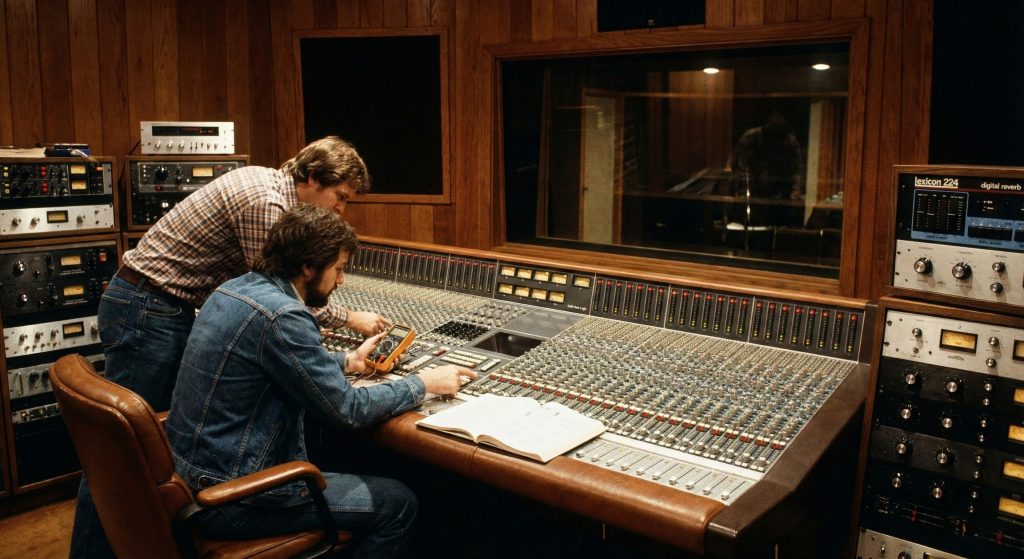
Just before wrapping up, it’s worth pausing to consider how the SL 4000 E became such a radically different console to anything else available at the time. The path to the E-Series doesn’t begin with traditional console designers in London or Los Angeles, but with Colin Sanders, an engineer whose background was far outside the usual audio world. Sanders founded Solid State Logic in the late 1960s to build computer-controlled switching systems for pipe organs; vast, intricate networks of relays and logic circuits that required silent routing, reliability and instant recall of complex states.

This systems-engineering mindset carried over when he built the first SSL consoles for his own Acorn Studios. The early SL 4000 A (only two were ever made) and the subsequent 4000 B (a handful more) introduced concepts that hinted at what was to come: inline architecture, computer-assisted automation, and the famously abusable Listen Mic circuit. But these desks were still essentially limited-run, early experiments.

The true leap arrived with the SL 4000 E in 1979. Here, Sanders’ out-of-the-box thinking came fully into focus: VCA dynamics on every channel, Total Recall for rotary controls, a dedicated master bus compressor, flexible routing, and a modular design that scaled to the increasingly dense, tape-heavy productions of the late ’70s and early ’80s. Where other consoles refined analogue traditions, Sanders redefined the entire brief, treating the console as a logic-driven control platform rather than simply a signal path with EQ.

That quietly radical shift - born from a background no one else in audio shared - created the workflow and sound that reshaped modern mixing; and it’s that design philosophy that the Waves SSL E-Channel continues to echo today.
Conclusion
Perhaps defying its age – although I guess that’s the point of emulating a console from the 1970’s? – the SSL 4000 E-Channel really surprised me with how capable it is. It’s so easy to get seduced by all the marketing out there for the latest and greatest emulations of vintage gear, that one could be forgiven for overlooking Waves’ version of the E series as a relic of the past. In reality, it’s a brilliant plugin that has a valuable place in my line-up of plugins. By putting so little strain on the CPU I can load an E-Channel onto every track in my session and my system won’t bat an eyelid.
The controls are really responsive, the sound changing instantaneously as I adjust them – unlike a couple of plugins I have from other manufacturers – and they shape the sound in a really musical way, effortlessly bringing some really valuable tone-shaping capabilities to the table.
The E-Channel is often on sale and, at the time of writing, is available for just $39 – which considering what it can do is immensely good value for money. You get a brilliant and flexible EQ section, HP and LP filters, a very versatile compressor, an expander/gate and if you work the plugin the right way, some really nice sounding saturation.
The plugin is available to buy on its own or part of several bundles, including Waves’ Essential and Ultimate subscription plans:
https://www.waves.com/plugins/ssl-e-channel
The manual, which as always is really worth a read, is available here:
https://assets.wavescdn.com/pdf/plugins/ssl-e-channel.pdf