

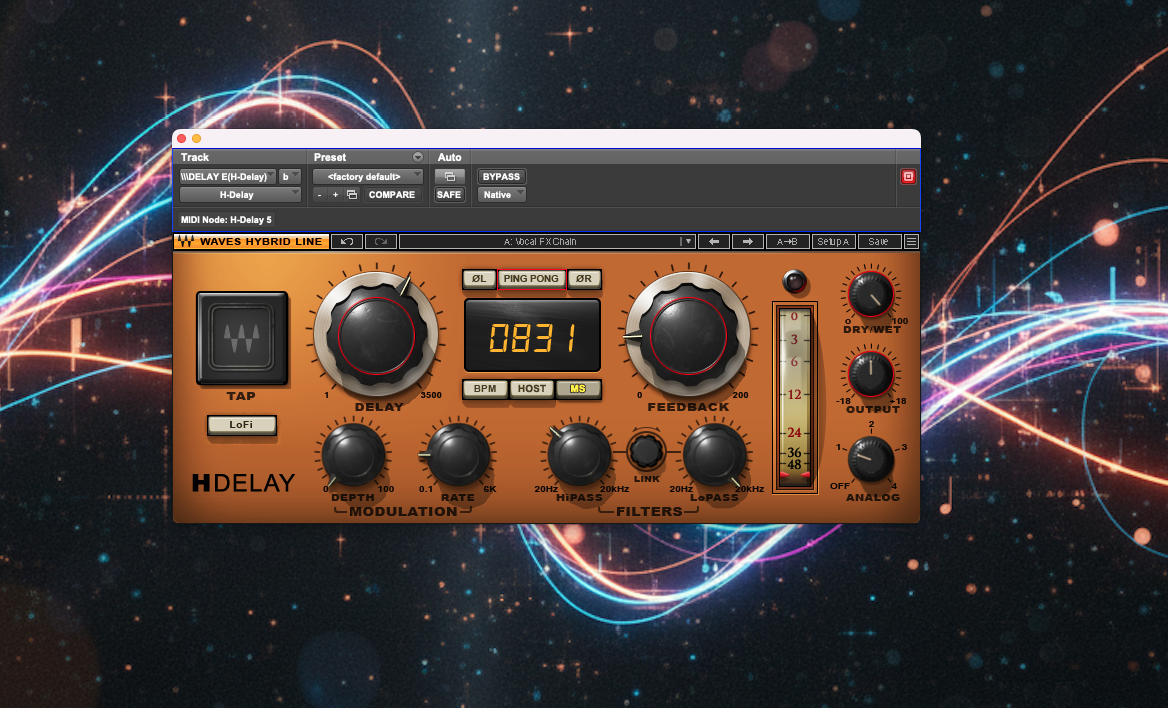
Delay is one of the most musically potent effects in audio production: it can deepen space, inject groove, double or thicken, add character or contrive weird and wonderful textures. The original hardware delay units of the ’70s-’90s (tape echoes, bucket-brigades, digital rack delays) still carry cult value, and many plug-in designers aim to recreate both the utility and the personality of those machines. Into that space enters Waves’ H-Delay: a “hybrid” delay plug-in positioned to straddle vintage character, modern flexibility, and ease of use.
From the outset, Waves quote that H-Delay offers “delays from 1 to 3500 ms, with sync-to-tempo; four analog characters or contemporary digital fidelity; sophisticated filtering; modulation (chorus, vibrato); and Lo-Fi options.”
It is ambitiously pitched as the “toolbox for classic delay effects”. Whether or not that claim holds up is what we’ll explore here.
Key Features and Specifications
Interface and controls
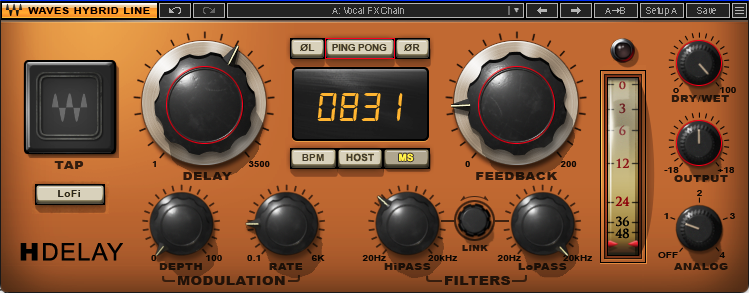
H-Delay presents a fairly compact, intuitive interface. You get controls for:
- DELAY time with a ‘TAP‘ pad for quick tempo matching and a delay range up to 3500 ms which is generous for creative effects as well as standard delay tasks.
- FEEDBACK control (including infinite feedback possibilities) for self-oscillation and dub-style loops.
- ANALOG character section (4 ‘Analog Modes’), a LoFi button, HiPASS & LoPASS FILTERS (which can be linked to make a band-pass shape) for shaping the tone of the repeats.
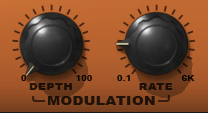
- A MODULATION section: LFO DEPTH & RATE controls which modulate the behaviour of repeats, allowing vibrato/chorus-style effects as well as pure echo.
- Stereo modes: PING PONG; separate L/R polarity flips (so you can flip phase on one side) for stereo creative uses; and Mono -> Stereo processing.
- MIDI learn support on all controls (so you can automate or control via hardware).
Specifications / Workflow Notes
- Works in standard plugin formats (AU, VST, AAX).
- Delay time can be set in ms or BPM (synced to host tempo).
- CPU load is minimal compared to some high-end delay models (users report it’s quite efficient).
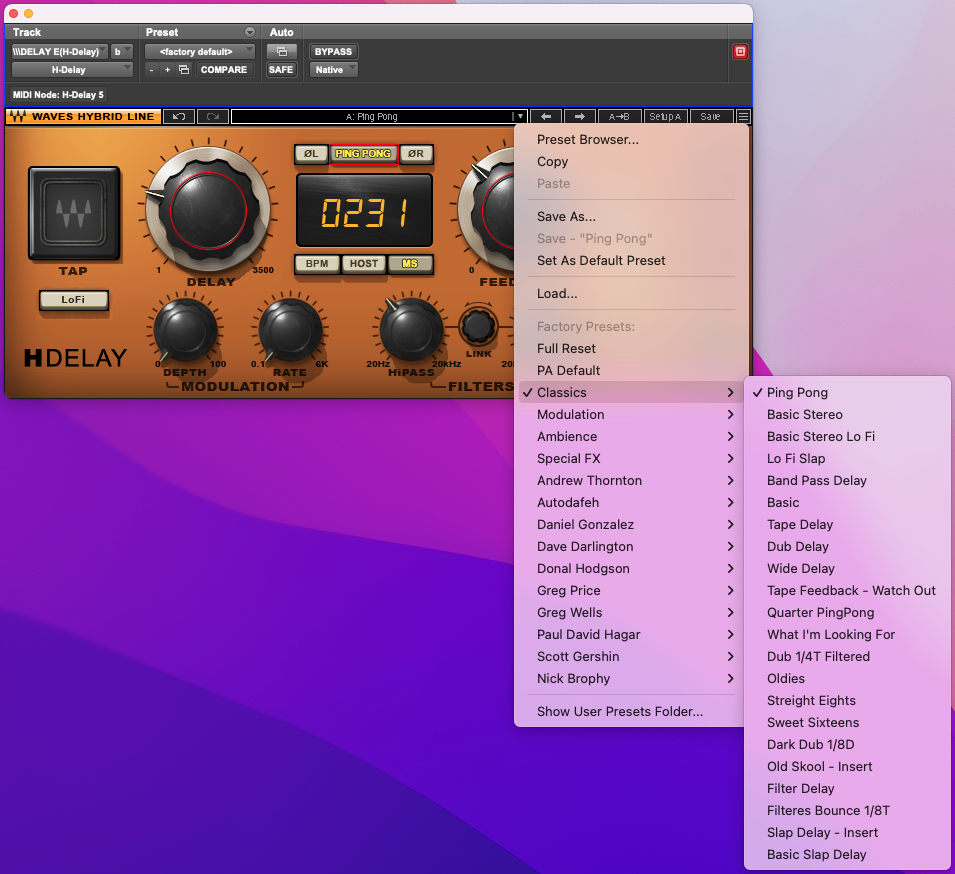
- Comes with a large preset library covering slap-backs, ping-pong, dub loops, and more experimental modulation-delay hybrids.
Sound Quality and Character
This is where a delay plug-in earns its keep or falls short. H-Delay’s sound character can be dissected in a few ways:
Vintage vs Modern Character
We have the ‘Analog’ modes (switchable from 1 to 4 and OFF) which attempt to simulate non-idealities of older hardware delay circuits (band-limiting, saturation, slight imperfection), and the Lo-Fi switch which further degrades sample-rate / bit-depth emulation for extra texture. These give the repeats more character than a sterile digital repeat, and from my listening they’re effective: enabling the Analog mode adds warmth, a little grit, and makes the repeats integrate more musically rather than sounding textbook clean. MusicRadar’s review notes “The analog modes are great for rounding off the edges and making the results less clinical.”
Repeat Tone and Filters
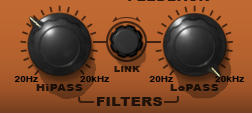
The built-in hi-pass/low-pass filters are a real asset: you can quickly tame high-end wash or muddy low end in the delay signal, which means the repeats sit more appropriately in a mix. H-Delay allows you to set HP and LP filters and optionally link them to form a band-pass, enabling effect-style delays with narrow tonal bandwidth. I sometimes find using a narrow band-pass on repeats, rather than full bandwidth echoes, can be a nice trick for creating ‘etherial’ or ‘fx’ delay tails.
Modulation and Creative Behaviour
The LFO on H-Delay can modulate the delay time (then feedback) to create chorus, vibrato or warped echo effects. Because the delay time range is large you can use it for anything from standard slap-backs all the way up to long ambient loops. I experimented with pushing the time high, adding infinite feedback, and enabling Lo-Fi + modulation: the effect can quickly become more like a sound-design tool than a simple delay. This versatility is a strong point and the plugin can help to create some really cool effects.
In-use; practical impressions
On vocals: H-Delay works very nicely for slapback and short echo sends. The analog modes help the repeat sit naturally behind the vocal rather than being overly pristine. The filters help reduce buildup (e.g., keeping high-end from washing out the mix).
On guitars: I love H-Delay on guitars; I found the ping-pong stereo mode (coupled with the filters) to be a go-to for creating movement in rhythm guitars or washes. Also the infinite feedback + modulation combination creates textured ambient guitar tails.
On drums / percussion: While delay fx don’t always take centre-stage when creating spaces for drums to live in, H-Delay can work really nicely on percussion fills or effects sends and as an occasional ‘throw’ effect. Because the interface is quick to use, you can dial in a tempo-sync delay for a tom fill or reverse-style echo, then automate it off. Slap-style delays also can be a really nice way of adding some thickness and extra dimension to drums.
For sound-design / effects: This is where H-Delay really shines. With infinite feedback, modulation, filtering and the analog/Lo-Fi options, you can sculpt everything from rhythmic stutters to looping chaos.
Ease of Use and Workflow
If your workflow is busy and you need a delay you can dial in quickly, H-Delay delivers. The interface is uncluttered and the main controls are obvious (Delay Time, Feedback, Mix, Analog/Lo-Fi, Filters). Many “big” delay plug-ins pack dozens or hundreds of parameters; H-Delay keeps things lean, and sometimes that just what you need. For example, in a review:
Waves H-Delay is just so simple to use… Great on guitars, synths, vocals, and more… this has been my go-to for as long as I can remember.
Russ Hughes – Production-Expert.com
The Tap-Tempo pad is handy, and the ability to switch between milliseconds or BPM timing adds flexibility; the stereo/ping-pong mode features are quick to access; and the filtering and modulation controls are are right there when you need them, not buried deep behind menus.
One small usability critique though: while the interface is strong, in certain cases the ‘Analog’ button can add a bit too much noise/hiss when engaged (especially at certain settings). It’s caused me more than a little bit of head-scratching on occasion, trying to find the source of a prominent hiss in a complicated mix session. On Gearspace one user pointed out:
The ANALOG knob @ 2 is creating a huge amount of hiss… at 1,3,4 and OFF there is no hiss.
Gearspace user
While this may not affect every system or setting, it’s a practical consideration and something to be aware of.
Preset organisation is solid: H-Delay ships with a wide range of useful presets (slapback vocal, dub infinite feedback, ping-pong rhythm, etc.), a big help when time is tight or when you want to use the plug-in as a creative starting point.
Comparisons
How does H-Delay stack up against some alternatives and what can it offer that others can’t?
vs Waves SuperTap, ValhallaDelay, Soundtoys EchoBoy: H-Delay is simpler and more direct than some of the ‘monster’ delay plug-ins. For example one Gearspace user wrote:
H-Delay is a very good but simple tape delay… EchoBoy wins by a rather wide margin
I’m not sure I agree that the margin is so large, but if you’re looking for ultra-deep parameter control, you might favour a more richly featured competitor. H-Delay wins when speed and simplicity matter and the sound quality can’t be faulted
vs internal DAW delays: Many DAWs now ship with capable delay units. The advantage of H-Delay lies in its tonal character (analog/Lo-Fi), filter options, ping-pong, and modulation. If you just want a basic slapback, you may already have the capability in your DAW; H-Delay adds more flavour and flexibility.
vs hardware-inspired boutique delays: While some boutique delay plug-ins try to model specific hardware (bucket brigade, tape echo, etc.) H-Delay takes a hybrid route: offering vintage-style character and modern delay flexibility. For many users this strikes a good balance.
Conclusion
At the end of the day, Waves H-Delay is a very capable delay plug-in that hits many of the right notes for engineers, mixers and producers who want solid functionality and character – without a deep learning curve or unwieldy parameter set. It does exactly what you expect from a well-designed delay: it delays, it echoes, it modulates, it colours, and it moves.
Is this a must-have delay plug-in? Possibly! If your workflow demands speed, good sound, and a delay you can trust and recall quickly, H-Delay is an excellent choice. If you spend your days diving deep into modulation routing, side-chaining delays, custom tap divisions, and advanced feedback matrixes, you might in time push against its limits and look to another plug-in with even more features.
For me, H-Delay is one of those plug-ins I regularly reach for without thinking twice – whether it’s for a vocal slap-back, a guitar stereo ping-pong wash, or a creative delay send in a post-production setting. It integrates cleanly, requires little setup, and gives reliable, musical results.
Verdict: Strongly Recommended. A versatile, characterful delay plug-in that blends vintage flavour and modern workflow with minimal fuss.