

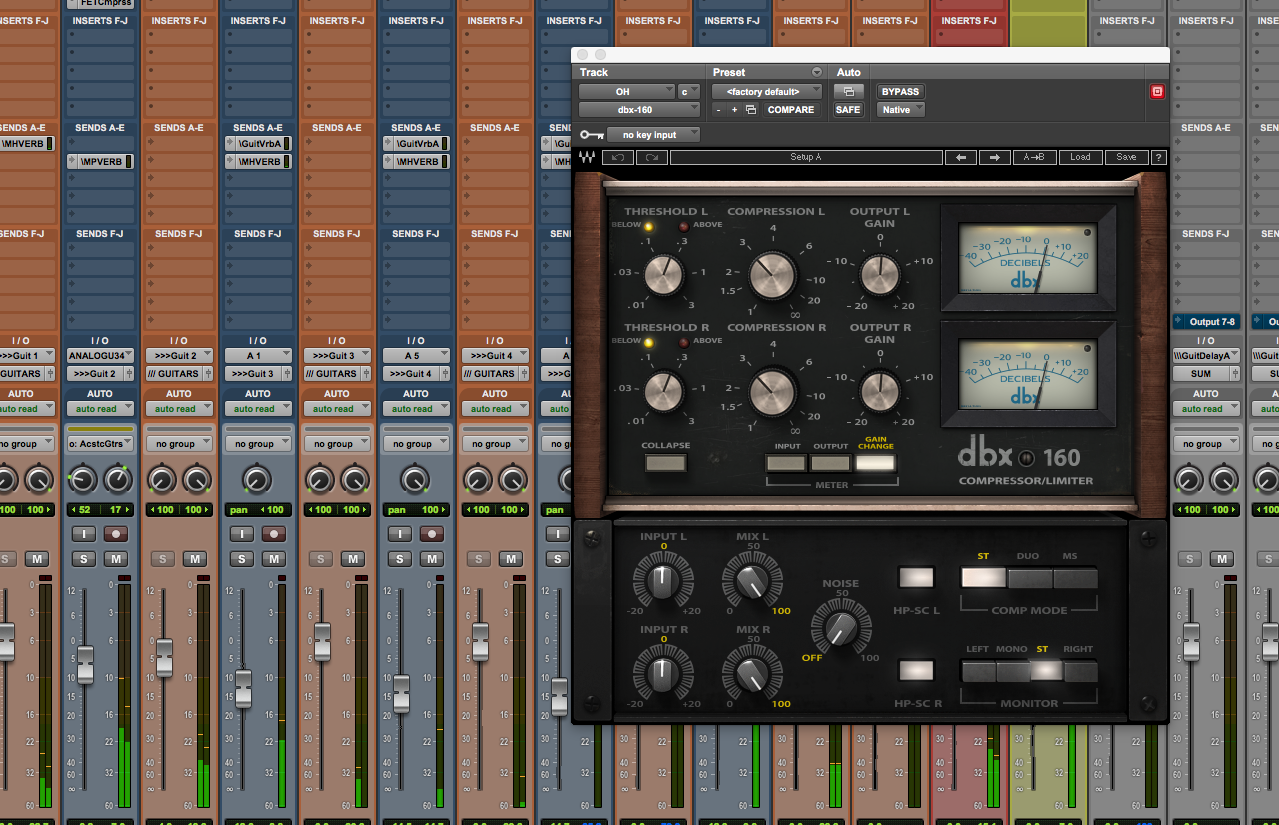
When the original dbx 160 compressor hit studios in the mid-1970s, it helped define what “punchy” meant. Its RMS level detection and feed-forward gain reduction circuits, “Over Easy” soft-knee, and fast, musical response made it a go-to for drums, bass, and vocals. Waves’ plugin version, developed in partnership with dbx and released in 2008, promises that same unmistakable grab and snap inside your DAW.
Interface & Features
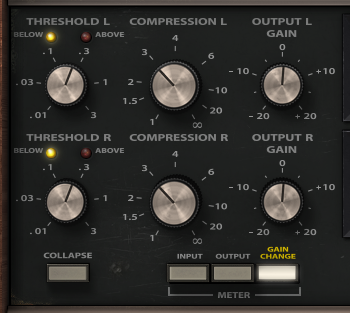
Waves’ GUI faithfully recreates the black lacquered metal front panel of the vintage hardware. You get the same three big knobs (split out into six for the stereo instantiation of the plugin) – THRESHOLD, COMPRESSION ratio, and OUTPUT GAIN – along with classic illuminated meters showing INPUT, OUTPUT, and GAIN CHANGE.
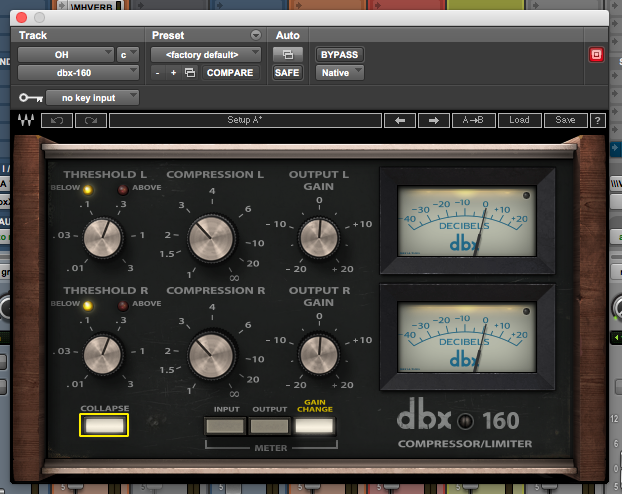
The plugin adds a few modern conveniences, accessible via the COLLAPSE button (replacing the original hardware unit’s POWER switch): an INPUT trim control, a MIX control, and three modes for the 2-channel instantiation of the plugin; ST (stereo), DUO (dual-mono), and MS (mid-side). There’s also a very useful high-pass sidechain filter function (HP-SC) which can be switched into the circuit at a fixed 90 Hz, and an analogue-modelled NOISE option, familiar from other Waves hardware emulation plugins.
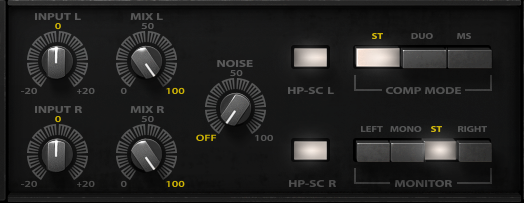
There’s not a lot more to it, and that’s part of the dbx 160’s charm: minimal controls, instant results.
CPU load is negligible on modern systems, as you’d expect from an older Waves design.
Sound & Character
The dbx 160 is famous for its grabby, almost tactile punch. Insert it on a snare, push the threshold down a few dB, and it adds that instantly familiar “thwack” — tight, controlled, and forward. The plugin captures that behaviour well, especially at modest ratios around 2:1 – 4:1.
I love dbx 160s on kick and snare, just barely touching them.
F. Reid Shippen (mixer/engineer: Dierks Bentley, Ingrid Michaelson, Keith Urban)
On kick drums it adds a solid, percussive attack that can make the low end feel more defined without muddying the subs. On bass guitar, it enhances note consistency and gives the line a pleasing density, though pushing it too far can produce a slightly choked midrange compared to the smoother API 2500.
Vocals fare less well: while it can certainly clamp peaks effectively, it doesn’t flatter a singer’s tone the way an LA-2A or R-Vox does. The release characteristic can feel abrupt, occasionally exaggerating sibilance or breathing.
The plugin maintains the dbx’s reputation for speed and simplicity — it’s not transparent, and that’s the point. Used tastefully, it injects attitude and cohesion; used aggressively, it becomes an effect.
Ease of Use
It’s almost impossible to get lost. With only three main knobs, you can dial in control in seconds. The meters are responsive and bright, and because there’s no auto-make-up-gain, your output gain decisions remain deliberate — a plus for experienced users, a mild inconvenience for beginners.
The NOISE pot introduces a faint noise floor and subtle saturation. I left it on most of the time; at conservative levels it adds a touch of realism without noticeable hiss.
Applications
- Snare and kick: Excellent – arguably its strongest use case
- Drum bus: Great for adding smack and density, though it can narrow the stereo image if pushed hard.
- Bass guitar: Adds punch and evenness, but don’t expect warmth
- Vocals: Functional, but there are smoother options
- Mix bus: Not ideal – it’s too heavy-handed for glue compression
Think of the dbx 160 as a colour compressor rather than a transparent leveler.
Comparisons
Compared with Waves’ CLA-76, the dbx 160 is slower on attack and less bright, trading aggression for weight. Against the API 2500, it’s simpler and punchier but far less flexible. Modern competitors like Softube’s DBX 160 and UAD’s DBX 160 arguable offer more refined modelling, with deeper harmonic nuance and a smoother envelope.
That said, Waves’ version remains perfectly usable, especially when you just need a quick, gritty compressor that behaves predictably.
Conclusion
Waves’ dbx 160 is a straightforward, effective compressor that still earns its keep in 2025 – particularly on drums and bass, where it tight VCA action delivers unmistakable vintage punch. it’s not the most sophisticated emulation out there, but it’s quick, reliable, and costs less than lunch in one of Soho’s pricier cafes.
If you already own the Waves Gold or Horizon bundles, t’s worth dusting off. If you’re after the absolute closest recreation of the original hardware, newer models from Softube or UAD edge it out.
Verdict: A solid, punchy workhorse – a little dated, but still get the job done.