

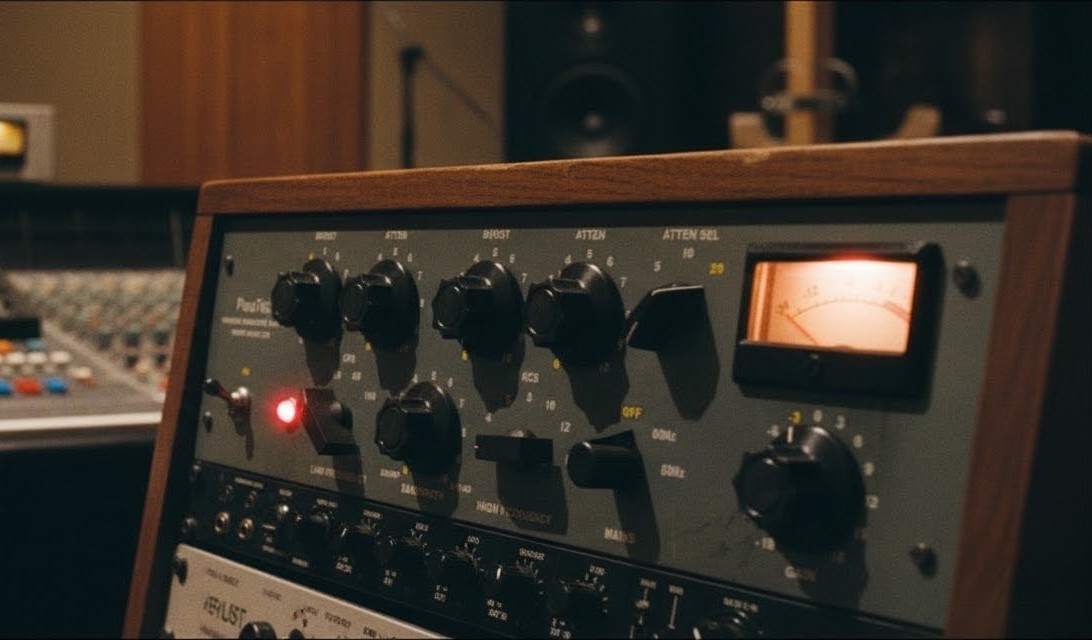
Back in the early 1950’s, if you wanted a Pultec EQP-1 it’d set you back about $400 – close to five grand in today’s money. Hardly pocket change, but plenty of studios snapped them up; Capitol, Decca, RCA Victor, Universal… the big names all bought in.
The EQ came from two friends, Eugene Shenk and Ollie Summerlin, who’d met at the ‘RCA Institutes’ electronics school in New York. A couple of years on they set up shop as Pulse Techniques, and the EQP-1 was one of their first hits under the now-classic Pultec badge.
Over the years the EQP-1 morphed into the EQP-1A and then the EQP-1A3, staying in production right up until 1981. By that point, Pultecs had made their way onto thousands of records, and engineers were hooked on the way they sounded – smooth, warm and musical.
The Pultec EQP-1A, the blue one. If I could only have three bits of gear, I’d have three of them … They are extraordinary.
Tim Oliver, Senior Consulting Engineer, Real World Studios
So yeah, they’ve got a reputation. Which is why Waves decided to take a crack at modelling them. In 2008, as part of the Jack Joseph Puig Collection, Waves released software versions of the EQP-1A and its midrange-focussed sibling, the MEQ-5, alongside plugin versions of the Fairchild 660/670 compressors. At launch the bundle was priced at $800 (or double that if you needed the TDM edition), but these days you’ll find it for way, way less.
The real question, though; 70 years after the original hardware’s release, and nearly 20 years since Waves released their plugin version, do the PuigTec EQs still earn a place in a modern plugin folder?
The EQP-1A and MEQ-5
Waves bundle the PuigTec EQP-1A and MEQ-5 together — you can’t buy them separately — and usually sell them as the “PuigTec EQs.” The price floats around (like most Waves plugins), but at the time of writing the bundle is for sale at $35. On paper, that’s a steal for two processors with this kind of heritage.
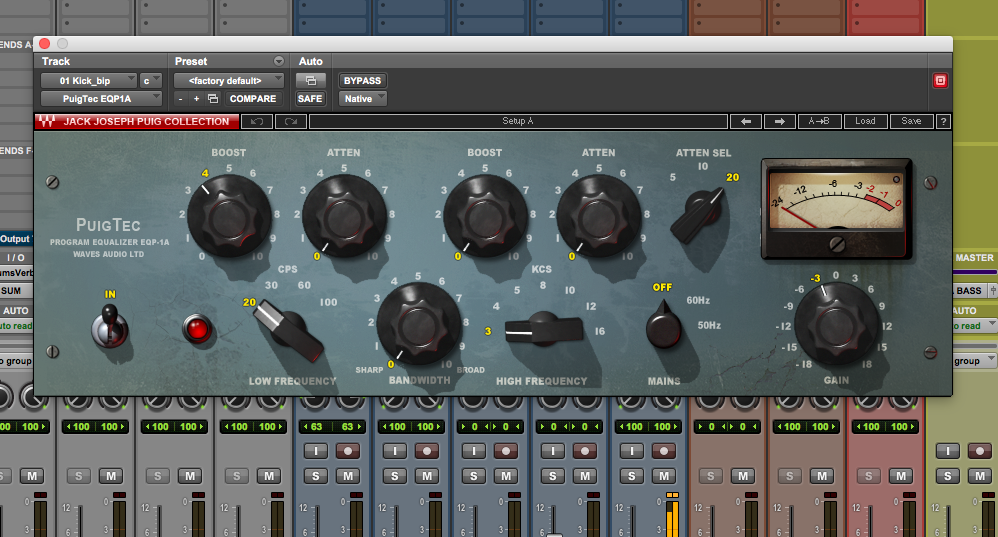
The EQP-1A is designated a ‘Program Equalizer’, i.e. meant for use on the Mix Bus or Sub Groups; but of course in reality people use them for all kinds of different things. Its controls give you access to a wide range of frequencies from a LOW FREQUENCY shelf with shoulder frequencies marked as 20, 30, 60 and 100 CPS (cycles per second), to a HIGH FREQUENCY shelf offering attenuation only at shoulder frequencies of 5, 10 and 20 kHz, (marked as Kilocycles Per Second, KCS), and a high bell BOOST (no attenuation) , with a bandwidth control, for frequencies centred on 3, 4, 5, 8, 10, 12 and 16 KCS. There’s also a VU-style dBFS output meter, an output trim ‘GAIN‘ control (with +/- 18dB of range in 0.1dB increments), an ‘IN‘ (bypass) switch and a MAINS hum function (which looks like the original’s power switch) – switchable between OFF, 60Hz and 50Hz.
The MEQ-5 equaliser targets the mid-range, with three bell filters offering up to 10dB of signal boost (‘PEAK‘) at 200, 300, 500, 700 and 1000 (Hz); up to 10dB of attenuation (‘DIP‘) at 200, 300, 500, 700 (Hz), 1, 1.5, 2, 3, 4, 5 and 7 (kHz); and up to 10dB of boost (again, labelled ‘PEAK‘) at 1.5, 2, 3, 4 or 5 (kHz).
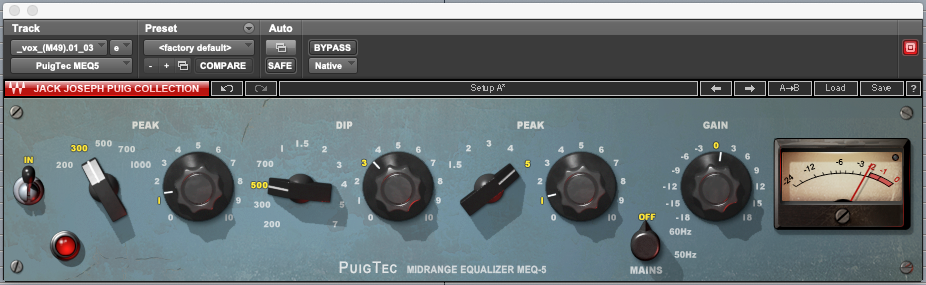
Like the EQP-1A, there’s a VU-style dBFS output meter, an output trim (‘GAIN‘) control, an ‘IN‘ (bypass) switch and the same switchable MAINS hum functions.
Both plugins model the original passive EQ + tube amp design, and Waves say they’ve gone deep on the details: the harmonic distortion, the transformer roll-off in the highs, even the background noise and hum from the old power supplies. In other words, they’ve tried to give you not just the curves, but the “feel” of the hardware.
Let’s look at the MEQ-5 first.
PuigTec MIDRANGE EQUALIZER MEQ-5
If you’ve never used a Pultec-style EQ before, it takes a bit of familiarisation. The MEQ-5’s controls are grouped in pairs – frequency selector and gain – with the two outer bands for boosting and the middle one for dipping.
I first tried it out on a beautifully recorded Motown-style male vocal. There was a slight boxiness at around 500 Hz though, and I wanted more brightness up top. Dialling in a dip at 500 Hz did the trick for the boxiness, which was a quick and easy solution, but the 5 kHz boost didn’t quite give me the “air” I was chasing. What I really needed was access to higher frequency boosts, and the MEQ-5 just doesn’t go there. I’d look at the vocal again when I got to the EQP-1A, but for now I turned my attention to the piano part in the same mix.
The piano sounded a bit thin, so I tried to warm it up by boosting at 200 Hz and 300 Hz. Both added some body, but also brought out a honkiness I didn’t like. I tweaked the bands for quite a while before giving up and reaching for my Pulsar Massive instead. I also gave the IK EQ-PA a spin — that was better than the MEQ-5 here, but still not as satisfying as the Massive.
So at this point, I hadn’t really clicked with the MEQ-5. But I persevered, this time on a rock track with some electric guitars that were nicely played but a little fizzy.
Here the MEQ-5 worked much better. I dipped at 7 kHz to tame the fizz, and boosted at 200 Hz to give the guitars some extra weight. That combination sounded solid, so I stuck with it.
Takeaway (so far)
The MEQ-5 can be useful, but it’s not a “go-to for everything” EQ. On vocals and piano I struggled to get what I wanted. On guitars it showed more promise. I get the sense it’s a plugin you reach for in specific situations rather than something you throw across every track.
PuigTec PROGRAM EQUALIZER EQP-1A
The EQP-1A is the more famous of the two, and probably the one most people reach for first. Like the MEQ-5, it’s not your typical “surgical” EQ — it’s broad, musical, and a bit quirky in the way the controls interact. That’s part of the charm.
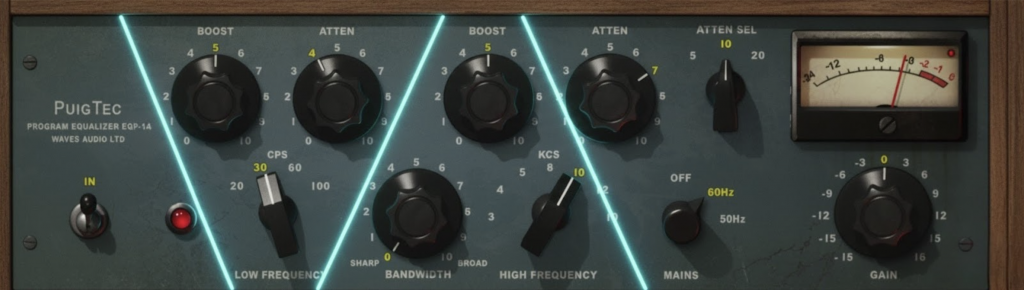
The esoteric layout of the controls can be seen in this image. There’s a LOW FREQUENCY shelf section containing a CPS selector for the shoulder frequency, a BOOST and an ATTEN knob; a HIGH FREQUENCY bell section with a BANDWIDTH and BOOST control for the chosen centre frequency; and an ATTEN SEL switch to select the shoulder frequency of the high shelf section which is cut (there’s no boost option) using the adjacent ATTEN knob.
A classic Pultec trick is to boost and cut the same low frequency at once. It sounds counterintuitive, but what actually happens is you get a resonant curve: the boost adds weight, while the attenuation reins in the mud just below it. The result is a lovely rounded low end that feels bigger without turning into a swamp.
The high end can be equally sweet. The bell boost, with its bandwidth control, gives you a wide range of shapes to add presence or air. And while the shelving cut only works at 5, 10 and 20 kHz, it’s surprisingly handy for taking the edge off harshness while still keeping clarity intact.
In practice, I find myself trying the EQP-1A on all sorts of sources:
The Motown vocal from earlier responded so much better to the EQP-1A. I dipped around 6dB at 60Hz with the low shelf, and boosted an indicated 5dB using the bell EQ at 12kHz, and the vocal was transformed – it hadn’t needed much, but the bottom end was cleaned up nicely and the boost at 12kHz added the HF clarity I was after. I had no need for the high shelf cut here, and so I moved on to looking for other sources that might benefit from the EQP-1A.
In the same track, the drums were already sounding pretty nice after just a quick fader balance, but the kick lacked a little weight and I felt I could get better extension into the deep lows. The highs were too prominent; they were a little edgy and distracting.
I used the low end Pultec trick with the CPS selector at 20, boosting and attenuating at the same time. It added the extra weight I was after, and I tweaked the high end with the HF bands. The result was a more balanced and rounded sound which fitted the production better. The top end was smoother and the bottom end had more solidity.
I tried the EQP-1A on the bass guitar next. A significant boost at 3k gave me the extra articulation I wanted, but no matter what I tried I couldn’t find a bottom end I was truly happy with. For a quick sanity check I inserted an IK EQ-PG graphic EQ and within a few seconds I had what I was after – a wider and fuller bass, with a substantial increase in its perceived size, with cleaner articulation up top and without getting in the way of anything else. The tone shaping abilities of the EQ-PG are so powerful and I often find I can get what I’m after really quickly.
Whilst I was here I figured I may as well have a crack at the piano, which was feeling a bit light and cold for the arrangement. No matter what I tried I kept getting the honkiness problem I’d had with the MEQ-5. There seemed to be no combination of boosts and cuts that would get me there. After quite a bit of head-scratching I decided to look into the phase relationships between the piano’s L-R mics. I inserted Pro Tools’ Time Adjuster plugin and delayed the right hand channel by 300 samples or so, and straight away the piano sound opened up, filled out the bottom end and lost the honky quality it had before.
I tried the EQP-1A again now that I’d sorted the phase relationship between the two piano mics, and it was a night and day difference with how the sound responded to EQ tweaks. This time I was able to dial-in some bottom end warmth without increasing the honkiness, and the top end sounded cleaner and freer. I even added a little at 8k to bring out the HF detail, and quickly the piano was starting get where I wanted it.
As with the bass guitar, I wanted to try the EQ-PG for a quick comparison – they’re quite different designs of EQ, but I felt it would be worth getting a different perspective to put the Pultec into context..
It’s not a “let me notch out that annoying resonance at 347 Hz” type of EQ — it’s about vibe, tone, and giving things a bit of glow.
The Sound vs The Hype
So how close do these Waves versions get to the hardware? That’s the million-dollar (or thirty-five dollar) question.
No plugin is going to fully capture the physical quirks of an original tube Pultec, especially one that’s been lovingly maintained for decades. But Waves did a respectable job modelling not just the frequency curves, but also the subtle saturation, transformer roll-off, and even the noise floor of the real units.
Do they sound exactly like vintage hardware? No. Do they deliver that recognisable “Pultec flavour” that makes things feel instantly more polished and musical? Yes, they really do.
And importantly, they do it in a way that’s fast and fun. The controls are simple, and half the joy of using them is just twiddling the knobs until something clicks.
Final Thoughts
The PuigTec EQP-1A and MEQ-5 aren’t surgical, all-purpose equalisers. They’re character tools. The EQP-1A especially is a classic for adding low-end punch or high-end sweetness, while the MEQ-5 is a bit more situational — less versatile, but sometimes just the right thing for guitars or tricky mids.
At full launch price they were a hard sell. At today’s prices, though, they’re a no-brainer. For the cost of a takeaway pizza, you get two plugins that put a genuine slice of studio history on your screen.
Are they perfect? No. Do they still earn a place in a modern plugin folder? Absolutely — especially if you like your mixes to have that little touch of vintage glow.