

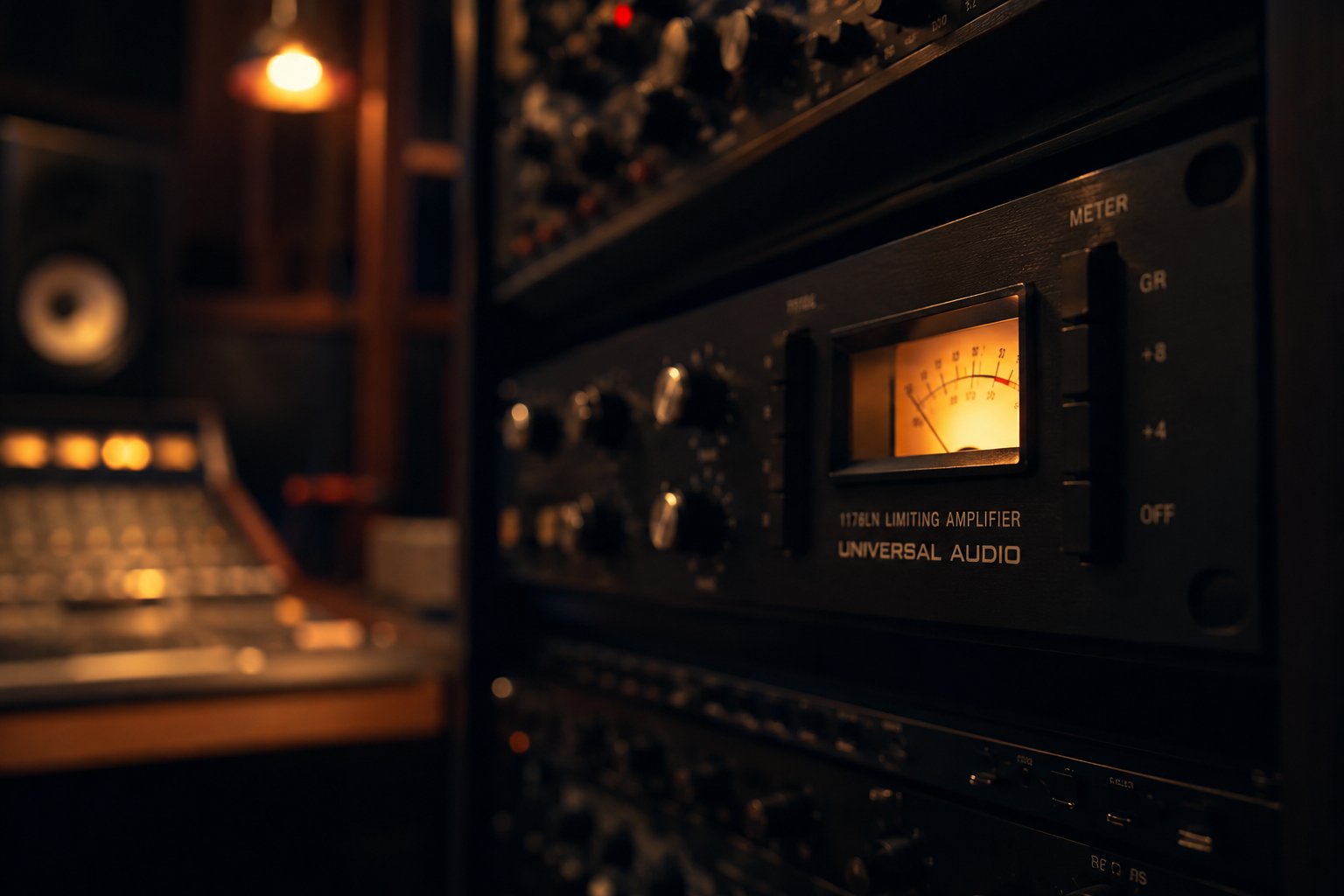
Few pieces of studio hardware have travelled through recording history with the same strange mixture of technical authority, sonic personality and almost mythological status as the 1176.
It’s a compressor, yes. A peak limiter, if we want to use its original language. But it’s also a marker of a particular moment in studio technology: the point where valve-based dynamics control gave way to solid-state speed, where recording engineers began demanding more repeatability from their equipment, and where a piece of outboard gear became not just a problem-solver, but part of the sound of records themselves.
The 1176 is fast, grabby, colourful and direct. It is famous for vocals, loved on drums, useful on bass, brutal in all-buttons-in mode, and still cloned, reissued, argued over and modelled in software more than half a century after its first appearance. For many engineers, it is one of those units that stops being a “compressor” in the abstract and becomes a musical instrument in its own right.
This is the story behind it: Bill Putnam, Universal Audio, UREI, the 175 and 176, the arrival of FET technology, the confusing but fascinating 1176 revision history, the engineers who made it part of studio language, and the reason manufacturers are still building new interpretations of the same basic idea.
Bill Putnam before the 1176
To understand the 1176 properly, we must start with Bill Putnam Sr.
Milton Tasker “Bill” Putnam was born in Illinois in 1920 and became one of the most important figures in post-war American recording. He was an engineer, producer, songwriter, businessman, studio designer and equipment designer. Putnam wasn’t just designing circuits; he was solving real studio problems from the control room outwards.
In 1946, he founded Universal Recording Corporation in the Chicago area, initially building a reputation around recording, broadcast transcription and technical experimentation. By 1947, Universal Recording had moved into Chicago’s Civic Opera Building, where Putnam famously used a bathroom as an echo chamber on The Harmonicats’ “Peg o’ My Heart”. Whether one wants to call it the first artistic use of artificial reverb in popular recording, or simply one of the most important early examples, it shows the essential Putnam pattern: use the building, the electronics and the recording chain together, and turn a technical workaround into a sound.
That same pattern would later appear in his studio designs, consoles and processors. Putnam thought in systems: rooms, cue feeds, echo sends, consoles, routing, monitoring and outboard equipment weren’t separate islands – they were parts of a unified recording environment. That’s why people like Bruce Swedien later described Bill Putnam as one of the fathers of modern recording. Putnam’s influence reached far beyond one compressor.
By the late 1950s, after success in Chicago, Putnam moved west. With encouragement from figures such as Frank Sinatra and Bing Crosby, Bill established United Recording in Hollywood. He later acquired neighbouring Western Recorders, creating the United Western complex on Sunset Boulevard. This wasn’t just a business move. It placed Putnam at the centre of the American entertainment industry at a time when recording technology, stereo, television, film sound and commercial music were all expanding rapidly.
United Western would become one of the great studio complexes, associated with artists including Frank Sinatra, Ray Charles, The Beach Boys, The Mamas & the Papas and many others. But behind the glamour was an engineering culture. Putnam was designing rooms, consoles and equipment because he needed his facilities to work consistently at a very high level, for very demanding clients.
That is the environment from which the 1176 eventually emerged.
Universal Audio, Studio Electronics and UREI: untangling the company story
One reason the 1176 story can feel confusing is that the words Universal Audio and UREI both appear in the same lineage; it can look as though Universal Audio later cloned a UREI product, but in reality, the story is much more continuous.
Universal Audio was founded by Bill Putnam Sr. in 1958 as the manufacturing arm of his studio operation. The point was to design and build professional audio equipment for his own rooms and, eventually, for other studios. Early Universal Audio products included the 610 modular preamp and console modules, along with custom studio electronics designed around the needs of United Recording, Western Recorders and Putnam’s earlier Chicago operation.
Studio Electronics was another important name in this chain. As Putnam’s manufacturing operation grew and reorganised, the business identity shifted. Universal Audio’s manufacturing activity became tied into Studio Electronics, which was then renamed UREI: United Recording Electronics Industries. The UREI name became the one most visibly associated with later 1176 production, but the design lineage still runs straight back to Putnam and Universal Audio.
Universal Audio, Studio Electronics and UREI are stages in the same Putnam-led manufacturing story, and the early 1176 units sit right in the middle of that transition.
Later, after Putnam sold UREI to Harman in the early 1980s, the original production history wound down. Bill Putnam Sr. died in 1989. Then, in 1999, his sons Bill Putnam Jr. and James Putnam re-established Universal Audio, bringing the family name back into hardware manufacturing and then into DSP plugin modelling. So the modern Universal Audio company is an authentic revival of the Putnam family’s recording technology legacy.
That is why the 1176 can be called both a Universal Audio and a UREI design, depending on the period, the faceplate and the context. The names changed. The lineage did not.
Universal Audio vs UREI: a quick overview

Universal Audio was Bill Putnam Sr.’s original manufacturing company, founded in 1958.

Studio Electronics was part of the same wider Putnam manufacturing story.

UREI, short for United Recording Electronics Industries, was the later company name under which many 1176 units were manufactured and sold.

Modern Universal Audio was re-established in 1999 by Bill Putnam Jr. and James Putnam, reviving the family legacy and reissuing the 1176LN before expanding into DSP, interfaces and plugins.

So Universal Audio’s modern 1176 is a reissue from the Putnam family lineage, separated by corporate history, branding changes and time.
Before the 1176: the 175 and 176
The 1176 didn’t just appear from nowhere. It was the solid-state descendant of Putnam’s earlier valve limiters, especially the 175 and 176.
The 175 and 176 were tube-based limiters designed for professional studio use. They belonged to a period when gain reduction was still associated with valves, large transformers, high voltages and relatively slow, rounded behaviour. These earlier units were prized for musical control rather than surgical speed. They had weight, tone and density, and they were designed for serious studio work, not as an afterthought bolted onto a broadcast chain.
The 176 is especially important because it gave Putnam a conceptual platform for the later 1176. It had selectable ratios and more sophisticated control than many earlier dynamics processors. In broad terms, the 1176 can be understood as Putnam looking at the 176 idea and asking: what happens if we keep the usefulness, control layout and studio practicality, but replace the slower valve-based gain reduction with something far faster and more consistent?
The answer was FET compression.
What made FET technology such a big deal?
A field-effect transistor, or FET, is a transistor whose conductivity is controlled by an electric field. In a compressor such as the 1176, the FET is used as a variable resistance element in the gain-reduction path. Put simply, the control circuit tells the FET how much to reduce level, and the FET can respond extremely quickly.
That speed was the revolution.
Compared with valve compressors, a FET-based design offered much faster response times, less warm-up dependency, no valves to wear out, and generally more repeatable behaviour from session to session. That doesn’t mean early FET circuits were sterile or perfect. Quite the opposite: early FETs and the circuits around them could be nonlinear in musically interesting ways. But they allowed engineers to catch transients with an urgency that older compressor types could not match.
To understand why that mattered, compare FET compression with other compression topologies:
A variable-mu compressor uses valve behaviour as part of the gain reduction process. It tends to be smooth, rich and programme-dependent. It is often wonderful on buses, vocals and mastering-style material, but it’s not generally the fastest way to grab a snare transient.
An optical compressor uses a light source and light-sensitive element. Audio is converted into light, the detector responds, and gain reduction follows. Optical designs can be beautifully smooth and forgiving, but the response depends partly on the physical behaviour of the opto cell. That lag, memory and recovery behaviour is a big part of the charm.
A VCA compressor uses a voltage-controlled amplifier. VCAs can be clean, controllable and precise, often with a full set of modern-style controls. They became central to console compressors, bus compressors and many later dynamics designs.
A FET compressor sits in a different emotional and technical place. It can react very quickly, it can be made compact and reliable, and in the case of the 1176 it does not sound clean in the boring sense. It is fast enough to catch peaks, but colourful enough to shape the tone of the material. That is the magic combination.
The people side of the technology is interesting too. The field-effect idea long predates the 1176. Early field-effect transistor concepts were patented in the 1920s and 1930s, long before practical manufacturing caught up. Bell Labs and the wider semiconductor industry later made transistor technology practical, and by the 1960s solid-state electronics were beginning to transform professional audio. Putnam was not inventing the FET itself. His genius was in recognising what this new type of component could do inside a studio dynamics processor.
He took an emerging technology and made it musical.
What does the FET actually do in an 1176?

In an 1176, the FET is used as the gain-reduction element.

That means it acts like a very fast, electronically controlled level-changing device. When the detector circuit sees that the audio level needs controlling, it applies a control voltage to the FET. The FET then changes its resistance and reduces the signal level.

That is the simple version.

The more interesting version is that the FET is not perfectly clean: its behaviour, especially when pushed, contributes to the 1176’s edge, urgency and harmonic personality. Combined with transformers, discrete amplifier stages and very fast attack/release behaviour, the result is not just “compression” - it's a distinct sound.
The original 1176: a solid-state limiter arrives
The original 1176 was designed by Bill Putnam in the mid-1960s and released in 1967. It was a major breakthrough: a true peak limiter with all-transistor circuitry and ultra-fast FET gain reduction. It kept the practical, studio-friendly simplicity of the earlier Putnam limiters, but it replaced the old valve world with a far faster solid-state design.
The front panel became part of the legend. Input, Output, Attack, Release, four ratio buttons, a VU meter and meter mode switching. No threshold knob in the modern sense. No graph. No menu. No hidden complexity. To compress more, you drive the Input harder. To compensate, you adjust Output. The ratio buttons set the general compression or limiting behaviour. Attack and Release shape how the unit responds.
The controls are simple, but the behaviour is not simplistic. Input affects gain reduction and tone. Ratio selection changes not only how much compression happens, but how the compressor feels. Higher ratios also change the threshold relationship. Attack and release interact strongly with the source. The unit is programme-dependent, meaning it responds differently to different material in ways that are not captured by a simple “ratio equals X” explanation.
That is why engineers often describe the 1176 in physical language. It grabs. It bites. It spits. It breathes. It lets drums jump. It makes vocals lean forward. Those descriptions are not just romantic language. They reflect how the circuit responds to transient material and how the amplifier stages colour the signal.
The 1176 revision timeline: blue stripes, black faces and silver panels
The 1176 revision history is one of the reasons people become obsessed with the unit. There is no single 1176 sound. There is a family of related sounds.
The early Revision A units, often called Blue Stripe or Bluestripe units because of the blue stripe across the meter section, are among the rarest and most characterful. They’re associated with more distortion, more attitude, a higher noise floor and a more obviously colourful personality. They represent the earliest Putnam FET limiter design in its wildest commercial form.
Revision AB followed quickly, improving stability and noise behaviour. This is already a theme in the 1176 story: the basic idea was excellent, but the circuit would continue to be refined as engineers learned how best to control the FET, reduce noise and improve manufacturability.
Revision B moved further away from the earliest configuration, including changes to the preamp section. It remained part of the blue-stripe era, but the 1176 was already evolving.
Revision C, arriving in 1970, is one of the biggest landmarks. This is where the black-face appearance and the LN suffix arrived. LN means Low Noise. Engineer Brad Plunkett designed an additional circuit to reduce noise and distortion by keeping the gain-reduction FET operating in a more linear region. In early form, this circuit was famously epoxy-encapsulated, partly to protect the design.
Revision D then integrated the LN circuitry more elegantly into a redesigned main printed circuit board. Revisions C, D and E are often grouped together in people’s minds as the classic blackface 1176LN era. They are lower-noise, more controlled and still extremely musical.
Revision E added a switchable mains transformer for 110V / 220V operation. Sonically, it sits very close to the D-era lineage, but it reflects UREI’s growing market and the practical need to sell professional equipment more widely.
Revision F, from 1973 onwards, made a more significant change by replacing the earlier Class A output amplifier with a push-pull output stage based on the 1109 preamp. This gave more output drive and a somewhat different sonic character. For some users, F revisions are cleaner and more robust; for others, the earlier Class A blackface units have more of the magic.
Revision G removed the classic input transformer and replaced it with an electronically balanced input stage. This was part of a broader 1970s shift in audio manufacturing, where op-amp and electronically balanced designs became attractive for cost, consistency and manufacturing efficiency. Sonically, it moves further away from the transformer-coupled early identity.
Revision H changed the front panel back to silver and added a blue UREI logo. By this stage, the 1176 had become a more mature product, but some of the rawness of the earlier units had been smoothed away.
This is why “which 1176?” is not a pedantic question! A Blue Stripe, a Rev D blackface and a later transformerless revision are not the same experiences. They share a control language and a compression family resemblance, but the amplifier stages, noise behaviour, transformer choices and distortion profiles all matter.
Quick 1176 revision guide

Revision A, 1967: original Blue Stripe. Rare, colourful, higher distortion, more noise, more attitude.

Revision AB, late 1967: early stability and noise refinements.

Revision B, late 1960s: preamp changes, still part of the blue-stripe lineage.

Revision C, 1970: first blackface 1176LN, with Brad Plunkett’s Low Noise circuit.

Revision D, early 1970s: redesigned PCB incorporating the LN circuitry more fully.

Revision E, early 1970s: broadly similar blackface character, with switchable 110V / 220V transformer.

Revision F, 1973 onwards: new push-pull output amplifier based on the 1109 preamp, more output drive.

Revision G: electronically balanced input stage replaces the input transformer.

Revision H: silver faceplate with blue UREI logo.

In short: Blue Stripe for colour and grit, blackface LN for classic controlled 1176 tone, later revisions for cleaner and more cost-efficient evolution.
The transformer and amplifier story
It’s tempting to think of the 1176 as “the FET compressor”, and of course the FET is central. But the rest of the circuit matters enormously.
Early 1176 units used transformer-balanced input and output stages. Transformers do several jobs. They balance the signal, help interface with studio equipment, provide isolation, and, crucially for audio people, add their own nonlinearities when driven. They can saturate, round, thicken or slightly reshape a signal depending on design and level.
The original 1176 output stage design used a Class A line amplifier, which contributes to the unit’s tone and density. Later revisions changed parts of this architecture. The Rev F output amplifier change and the Rev G removal of the input transformer are not just engineering trivia. They help explain why different revisions can feel different under the fingers.
A compressor is not only the gain reduction element. It is the whole path: input amplifier, detector, gain-reduction element, output amplifier, transformers, power supply, metering and calibration. This is why clone manufacturers and plugin developers obsess over which revision they’re modelling. Small changes in the audio path can change the way the unit saturates, recovers and presents transients.
All-buttons-in: the accident that became a sound
One of the 1176’s most famous behaviours was not originally a formal feature.
The ratio buttons were designed for single selection: 4:1, 8:1, 12:1 or 20:1, but engineers discovered that pressing multiple buttons, especially all of them at once, produced a dramatic and very different response – the compression curve changed, distortion increased, the unit became more explosive, more nonlinear and more obviously coloured.
This became known as all-buttons-in mode, British mode, or sometimes nuke mode. It’s particularly associated with drums and room microphones. Smash a pair of room mics through an 1176 in all-buttons mode and the ambience surges forward between hits. The snare seems to throw the room open. Cymbals can get fierce. The whole kit can feel larger, dirtier and more urgent.
It is not polite compression. It is not transparent compression. It is compression as effect.
That is part of the 1176’s genius. It can behave like a conventional compressor at moderate settings, a peak limiter at higher ratios, a tone box when driven, and an instrument of destruction in all-buttons mode.
Why studios adopted it
The 1176 became embedded in professional studios because it solved a number of real-world problems at once.
It was fast enough to catch peaks. That made it useful in tracking, where controlling a vocal or bass before tape could prevent overload and help the performance sit better.
It was simple to operate. Engineers could set it quickly under pressure. In a professional session, speed matters. A tool that sounds good and can be adjusted quickly earns its place.
It was characterful. The 1176 did not merely reduce level. It added presence, density and excitement. That made it especially attractive in a world where records had to translate through radio, vinyl, television and later increasingly dense multi-track mixes.
It was versatile. Vocals, bass, snare, kick, guitars, room mics, percussion, parallel buses: the 1176 could do useful work across a session. A studio that owned several units could keep finding jobs for them.
And it became self-reinforcing. Once major engineers used 1176s on major records, other engineers heard those records, worked in those studios, adopted those habits and passed them on. The 1176 became part of the language of recording.
Famous uses and famous users
It is difficult to give a perfectly complete client list for a hardware processor that’s lived in so many studios, because 1176s were often, and still are patched in as part of everyday engineering rather than celebrated as special effects. But the documentary trail is strong enough to show how deeply it entered studio practice.
Bruce Swedien, who worked under Bill Putnam early in his career and later became famous for his work with Quincy Jones and Michael Jackson, is often linked to the 1176’s vocal tradition. The broader Putnam / Universal Recording world shaped Swedien’s early professional environment, and the 1176 later became one of the standard tools discussed in relation to classic vocal compression.
Chris Lord-Alge is one of the most visible modern 1176 devotees, particularly through his use of Blue Stripe and blackface units. His aggressive, forward, rock-and-pop mix aesthetic is almost inseparable from fast compression. The fact that Waves later modelled his 1176s for the CLA-76 plugin is a reminder that by the 2000s, certain individual 1176 units had themselves become famous.
Tom Elmhirst’s use of a blackface 1176 in the vocal chain for Amy Winehouse’s “Rehab” is another useful modern example: fast compression used not as a novelty, but as part of a serious vocal sound. Hugh Padgham’s use of 1176s on room mics in the context of Phil Collins’ “In the Air Tonight” is one of the most famous drum-related examples, because it connects the unit with the explosive room sound that became part of 1980s production language.
There are many others: Mike Shipley, Jim Scott, Andrew Scheps, Andy Johns, Ed Cherney, Joe Chiccarelli and plenty of engineers who may not be publicly associated with a single 1176 anecdote but have used the topology constantly. The point is not that the 1176 belongs to one genre or one school. It belongs to studio practice itself.
The 1178: the related stereo cousin
No 1176 hardware history is complete without mentioning the 1178.
The 1178 was effectively a stereo relative of the 1176LN, but it was not simply “two classic 1176s bolted together”. It used different circuitry, including a transformerless input stage, and is often described as cleaner or smoother than earlier 1176 units. It offered stereo operation in a more integrated format, which made it useful in contexts where two matched mono units were not ideal.
The 1178 has never quite had the same mythic status as the 1176, probably because the mono 1176 became so deeply tied to vocals, bass and individual track processing. But the 1178 is important because it shows how the same FET compression idea could evolve into a more stereo-friendly, slightly cleaner, more controlled tool.
Modern plugins such as Pulsar 1178 have helped renew interest in that branch of the family tree, especially for drum buses, mix buses and stereo material where FET speed is desirable but the full grit of a blue-stripe 1176 is not always the goal.
Discontinuation, reissue and the modern Universal Audio revival
After Bill Putnam sold UREI to Harman, the original corporate chapter changed. UREI continued for a time, but the classic Putnam-era manufacturing culture was no longer the same. Eventually, the original 1176 production story came to an end.
Then came the revival.
In 1999, Bill Putnam Jr. and James Putnam re-established Universal Audio. One of their first major acts was to reissue the 1176LN, drawing on the family legacy, original documentation and the most desirable blackface revision lineage. This was a significant moment. It positioned Universal Audio not merely as a nostalgic brand, but as a company attempting to reconnect modern studios with the original Putnam hardware tradition.
From there, Universal Audio moved into DSP modelling. Its early UAD platform launched with an 1176 plugin, and later UA developed far more detailed 1176 collections that modelled multiple revisions, including Rev A Blue Stripe, Rev E Blackface and the 1176AE Anniversary Edition. The hardware and software strands became mutually reinforcing: the physical 1176 remained a flagship object, while the plugin versions brought the sound into modern workflows.
This is one reason the 1176 continues to matter commercially. It is not frozen in the 1960s. It has been repeatedly reinterpreted for each studio era: original hardware, blackface refinement, later UREI production, modern UA reissues, boutique clones, DIY kits and detailed software emulations.
The clone explosion
The number of 1176-style compressors now available is astonishing. Universal Audio makes reissues. Purple Audio makes the MC77. Warm Audio makes the WA76. Klark Teknik makes the 76-KT. Black Lion Audio makes the Bluey, based on Chris Lord-Alge’s heavily modified unit. Stam Audio, Hairball Audio, AudioScape, Lindell and many others have produced their own takes on the design.
Why do so many exist?
Partly because original units are expensive and finite. Partly because the circuit is famous enough to sustain a whole ecosystem. But more importantly, because the 1176 is not one perfectly fixed sound. The revision history creates room for interpretation. A manufacturer can chase Rev A aggression, Rev D blackface balance, Rev F drive, modern reliability, lower noise, stereo linking, transformer options, stepped controls, improved power supplies or budget accessibility.
The 1176 clone world is therefore not just imitation. At its best, it is a conversation with the original design.
A Klark Teknik 76-KT, for example, makes the basic experience of hardware 1176-style compression available at a remarkably low price. It is not a vintage UREI and does not pretend to be one, but it gives modern engineers the tactile experience of driving a fast FET compressor in real time. A Warm Audio WA76 offers another affordable route, with its own transformer and voicing choices. Purple Audio’s MC77 is a more boutique, refined, modern professional take. Black Lion’s Bluey leans into the story of one specific modified unit. Hairball caters to the technically adventurous DIY community, where builders can learn the circuit almost by physically inhabiting it.
That range tells us something important. The 1176 is not only a product. It is a platform.
Why boutique 1176 clones are not all the same

A 1176 clone can differ from another 1176 clone in many ways.

It may be based on a different revision. It may use different input and output transformers. It may use modern substitute components where vintage parts are unavailable. It may have different calibration behaviour, different metering, different power supply design, different build quality, different noise performance and different headroom.

Even if two units share the same control layout, they may not grab, distort or recover in exactly the same way.

That is why shootouts are so interesting, but also why they can be misleading. The “best” 1176 is not always the most accurate one. It is the one that does the right thing to the right source in the right mix.
What plugin modelling changed
The 1176 has also become one of the great tests of analogue modelling.
Early digital emulations could reproduce the broad control behaviour: attack, release, ratio, gain reduction. But the deeper challenge is modelling the whole electronic path: transformers, amplifiers, FET nonlinearities, programme dependency, distortion, input clipping, noise, metering ballistics and all-buttons-in behaviour.
Modern plugin development has moved much further into component-level and circuit-aware modelling. Developers increasingly model not only the gain reduction curve but the saturation behaviour of the input stage, the output amplifier, the transformer response, the detector path and even the ways different revisions react when driven. Some newer plugins also add features no hardware 1176 ever had: mix controls, headroom controls, sidechain filters, mid/side modes, lookahead and stereo link options.
Does that mean modern emulations are dramatically better than earlier ones? Sometimes, yes. A newer model may capture distortion and transient behaviour more convincingly, especially at extreme settings. But the important thing is musical usefulness. A less forensic emulation can still be very effective in a mix if it captures the essential timing, density and attitude.
The 1176 is a reminder that modelling is not just accuracy. It is choosing which parts of a complex analogue behaviour matter most to the user.
Why engineers still care
The enduring appeal of the 1176 is not difficult to understand if you use one regularly.
On a vocal, it can turn uneven energy into focus. It catches peaks, adds urgency and often makes the singer feel closer to the listener.
On bass, it can make the line more reliable without completely sanding off the performance.
On drums, it can move from sensible control to absolute violence. Snare, kick, rooms and parallel buses all give the 1176 room to show its personality.
On guitars, it can smooth pick attack, add sustain and help parts sit in a mix.
But beyond individual sources, the 1176 has a psychological quality. It is a fast decision tool. You do not tend to sit in front of it for twenty minutes fine-tuning graphs. You drive it, listen, back it off or push it harder. It rewards instinct.
That is perhaps the most Putnam-like thing about it. For all the clever electronics, the 1176 feels like a studio tool designed by someone who understood sessions. It is not an academic exercise. It is a box for making records.
The 1176 as legacy
The 1176 sits at a fascinating crossing point.
It connects valve-era studio craft to solid-state electronics. It connects Bill Putnam’s practical studio inventions to modern plugin modelling. It connects Hollywood studio culture to home studio racks. It connects technical design choices, FETs, transformers, amplifier stages and metering, to something much less measurable: excitement.
That is why the 1176 keeps coming back. Every generation finds a new way to use it, clone it, reinterpret it or argue about it. Engineers debate revisions. Manufacturers compare transformer choices. Plugin developers model circuit paths in finer and finer detail. Beginners discover all-buttons-in on drum rooms and suddenly understand why everyone keeps talking about this old box.
There are cleaner compressors. There are smoother compressors. There are more flexible compressors. There are more transparent compressors.
But there are very few compressors with this combination of speed, attitude, history and sheer usefulness.
The 1176 became a classic because it arrived at exactly the right intersection of technology and musical need. It gave engineers a new kind of control, but it did not remove personality from the signal. It was solid-state, but not sterile. Fast, but not flat. Practical, but full of attitude.
More than half a century later, that is still the reason it matters.
For a closer look at one of the most familiar plugins in this whole category, read our full Waves CLA-76 Compressor / Limiter review. In that article, we dig into the CLA-76’s Bluey and Blacky models, its classic 1176-style workflow, its strengths on vocals, drums, bass, and parallel compression, and whether this long-standing Waves favourite still earns its place alongside newer FET compressor plugins.