

Introduction
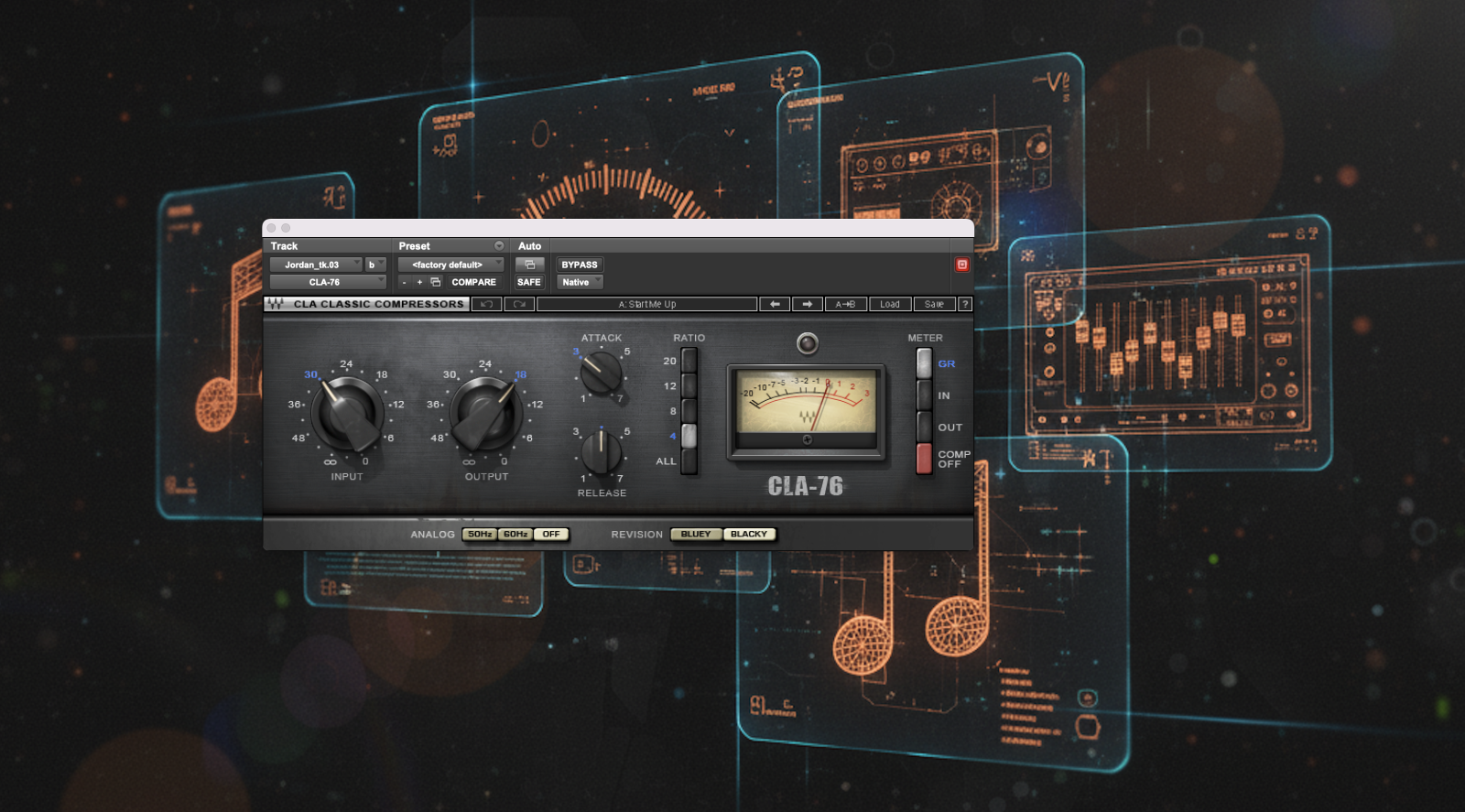
The Waves CLA-76 is not just another vintage-style compressor plugin. It’s Waves’ take on one of the most influential dynamics processors ever made: the UREI / Universal Audio 1176, a FET compressor whose speed, attitude and sheer usefulness have made it a studio fixture that spans generations, across vocals, drums, bass, guitars and countless other sources.
Waves launched the CLA-76 as part of the CLA Classic Compressors collection in 2009, building it around two of Chris Lord-Alge’s own favourite hardware units: a Blue Stripe-style revision and a Blackface-style revision.
That lineage is important: 1176-style compression is still one of the fastest ways to make tracks sound more finished, more controlled and more exciting, and it’s not the sort of compression that politely disappears into the background. A good 1176, or 1176-style compressor can add urgency, bite, density and a very particular kind of forward motion that mix engineers still lean on every day.
So the questions to ask are: how well does the Waves CLA-76 still hold up now that the plugin market is crowded with excellent FET compressors, what do Bluey and Blacky actually give you, and is this still a worthwhile buy if you want authentic 1176-style compression inside the box?
Let’s start with the original hardware story. The history of the 1176 is more than an interesting sidenote; it explains why this type of compressor behaves the way it does, why engineers still care about 1176 revisions, and why Waves’ choice to model Chris Lord-Alge’s own units gives the CLA-76 its particular identity.
Why the 1176 still matters
The original 1176 is important because it arrived at a moment when studio technology was changing quickly. Bill Putnam Sr., founder of Universal Audio, was already a major recording innovator, and the 1176 marked an important move from earlier valve-based compressor designs into fast solid-state FET compression.
Universal Audio still describes the 1176 as a major breakthrough built around ultra-fast FET gain reduction, and that description is not mere marketing fluff – fast transient control is exactly what makes the unit so powerful in real studio work.
Waves’ own CLA-76 manual gives a neat sense of the hardware’s scale and legacy. It notes that the original unit went through at least 13 revisions, that roughly 8,000 were manufactured, and that Waves modelled two of the most musically significant types for this plugin: Revision B, the Silverface Bluestripe, and Revision D-LN, the Low Noise Blackface.
Those revisions don’t just look different – they have different gain stages, time constants, THD behaviour and noise characteristics, and engineers can get oddly tribal about which one they prefer.
But what made the 1176 so widely loved was not just that it was fast. It was that it was fast and flattering. The hardware became famous for grabbing peaks hard while still sounding energetic and musical. It could make a vocal feel more urgent, a snare feel more alive, a bass feel firmer, or a drum room sound as if it had suddenly doubled in size.
That’s why the 1176 remains relevant to newer engineers. It’s not a nostalgia piece: it’s became a standard because it solves real problems in a musically attractive way. If a vocal needs to hold its place in a dense arrangement, if a bass line needs more authority, if a drum room needs to erupt into life, an 1176-style compressor is still one of the first tools many mixers will reach for.
Bill Putnam, Universal Audio and UREI

Bill Putnam Sr. was one of the most important figures in recording technology. Universal Audio was the original manufacturing arm behind his studio operation, and the 1176 emerged from that wider engineering lineage.

Later branding and corporate changes can make the story feel slightly messy on paper, but the essential thread is clear enough: the 1176 belongs to the Putnam tradition of practical, great-sounding studio engineering, and its influence has continued right through to modern UA hardware reissues and plugin emulations.

For more info on Bill Putnam and the history of the 1176 compressor, take a look at our 1176 history deep-dive article here.
What Waves CLA-76 actually is
Waves didn’t pitch the CLA-76 as a generic “inspired by a classic compressor” product. The whole point was that Chris Lord-Alge gave Waves access to the specific units he prized most, and worked with them through the modelling process.
Waves’ manual explicitly states that the plugin is based on CLA’s preferred Revision B unit and a Revision D-LN Blackface, and that he worked closely with Waves engineers throughout development.
And Chris Lord-Alge isn’t just a famous endorser – he is one of the defining rock and pop mix engineers of the modern era, and he’s particularly associated with punchy, dense, compressor-forward mixes. If a plugin says it captures some of his preferred hardware, that’s a strong clue about the design goal: this plugin is meant to be immediate, musical, practical and unapologetically mix-focused.
Waves launched the CLA Classic Compressors bundle in July 2009, when native analogue-modelled compression was already becoming a serious market but before the current flood of ultra-detailed 1176 alternatives. That timing helped the CLA-76 become a staple. It offered recognisable 1176-style compression, native operation, low friction and the appeal of two classic flavours in one interface.
Even now, that basic proposition remains strong. The CLA-76 certainly isn’t the newest FET compressor on the market, but it’s still one of the most familiar and widely used. Part of that comes down to sound. Part of it comes down to workflow. And part of it comes down to the fact that, unlike some heavier modern emulations, it still feels like a plugin you can throw on tons of tracks across a session without worrying too much.
CLA-76 controls and interface
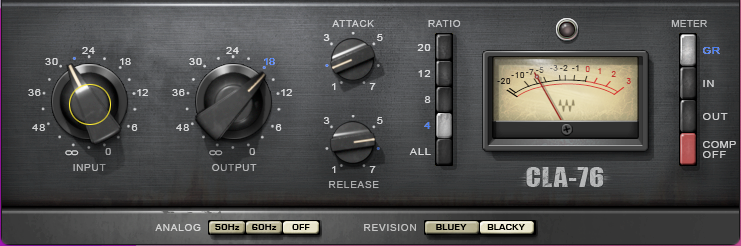
The CLA-76 looks like what it is trying to be: a hardware-style compressor with a strong visual connection to the original 1176 layout. You get Input and Output controls, Attack and Release, ratio selection, revision switching, analogue hum options, VU metering, Mix and Trim.
The current Waves manual also lists Auto Makeup, Comp Off, mono and stereo components, and plugin resizing through the WaveSystem toolbar, which means the modern CLA-76 is actually more flexible than many people remember from older versions.
The most important thing for newer users to understand is that this is an input-driven compressor. In other words, you don’t set a compression threshold in the usual sense. You push more signal into the circuit with the Input control, and then compensate with the Output control. The Auto Makeup function can help to keep the level more stable as you drive the Input harder.
It’s a fast and satisfying way of working.
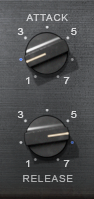
Attack and Release follow classic 1176 logic rather than modern “more number means more time” logic. On the CLA-76, 1 is slowest and 7 is fastest. Waves says that attack runs from around 1 millisecond down to less than 50 microseconds, and release from around 1 second down to 50 milliseconds.
That fast end is a huge part of the plugin’s character. It can get hold of transients in a way that slower compressor types simply cannot.
Ratio options are 4:1, 8:1, 12:1, 20:1 and All. The All setting recreates the famous all-buttons-in behaviour of the original hardware, which Waves describes as aggressively compressed and distinctly distorted. That description’s spot-on – all mode is not subtle. It’s one of the quickest ways to turn room mics, parallel drums, and occasional bass or vocal effects into something gloriously unruly.
What all-buttons-in mode actually does

The original 1176’s ratio buttons were intended to be mutually exclusive, but engineers discovered that pressing them together created a much more aggressive, distorted and explosive response.

Waves models that behaviour directly in the CLA-76’s All mode, and describes it as arising from changing FET bias in the original design.

It is especially good for parallel drums, trashy room mics, and occasional attitude-heavy vocal or bass effects.
Revision switching is one of the plugin’s biggest strengths. Bluey gives you the Bluestripe-inspired flavour, Blacky gives you the Blackface-inspired one, and the differences are sonically useful, more than just cosmetic.
Analog lets you choose Off, 50Hz or 60Hz hum behaviour, with modelled noise and hum based on the original units. Metering can be switched between input, gain reduction and output, and Mix lets you blend dry and compressed signal directly in the plugin, which is a genuinely valuable convenience on a compressor like this. Trim then gives you final output adjustment after the blend stage.
Comp Off is easy to miss, but it’s a nice addition to the current version. Waves describes it as bypassing compression while still emulating the pleasing distortion caused by the hardware’s preamp path. It gives you a handy way to use the plugin as a colour stage rather than a compressor when you want a bit of edge, density or analogue-style push without active gain reduction.
Workflow-wise, the CLA-76 is one of those plugins that tends to get out of the way quickly. There is not a forest of panels and hidden menus to navigate. Once you understand the reverse-numbering on Attack and Release, and once you get used to driving compression with Input, it becomes very quick to set by ear.
That simplicity is part of why it has lasted so well.
Bluey vs Blacky: what’s the difference?
It’s a useful thing to understand about the CLA-76, because it’s one of the plugin’s real advantages.
Bluey is the more vivid, slightly rougher, more characterful personality. It tends to feel more forward in the mids, a little more eager to add urgency, and a little easier to push into attitude. If you want a vocal to step forward, a room mic to get rowdier, or a snare to feel more alive, Bluey is often the first place to start.
Blacky is the steadier and slightly more general-purpose option. It still has the unmistakable speed and shape of 1176-style compression, but it usually feels a touch smoother and a touch less insistent in the mids. On bass, bus duties and more conservative vocal compression, Blacky often feels like the easier fit.
Waves’ documentation supports this broad picture, noting differences in gain stages, time constants, THD and noise levels between the modelled revisions. That is exactly how the plugin behaves in use. These aren’t radically different compressors, but they are meaningfully different flavours of the same design.
Don’t turn that into a rigid rulebook though: Bluey is not “vocals only”, and Blacky is not “basses only”. They overlap heavily. But if you are new to the plugin, thinking of Bluey as the slightly more urgent and colourful one, and Blacky as the slightly more composed and all-round one, will get you very close very quickly.
1176 revisions quick overview

Early Bluestripe-style units are generally associated with a slightly rougher, more vivid, more harmonically colourful sound. Later Blackface low-noise units are generally associated with smoother, steadier, lower-noise operation.

That's an oversimplification, but it's exactly the distinction Waves is leaning into with Bluey and Blacky, and it's enough to make the plugin’s two revision modes feel musically meaningful rather than merely historical.
What 1176-style compression is especially good at
A good 1176-style compressor is brilliant when you want control plus character.
It is particularly good at fast peak control. That might sound obvious, but it matters. On an energetic vocal, a spiky snare, a slapped bass, or a sharply picked guitar, a slower compressor can let too much through before it reacts. An 1176-style design can get hold of that transient material quickly enough to reshape the feel of the performance.
An 1176 is also very good at making things feel more forward. This is one reason 1176s became so loved on vocals. They don’t just level. They can make a source feel more insistent, more committed, more “already in the record”. That same trait is useful on bass and drums, where extra density and urgency can help parts sit more confidently.
Another classic use is parallel compression. Because 1176-style compressors can sound exciting when pushed hard, they are ideal for blending back in underneath a cleaner original signal. Room mics, drum buses, basses and even certain lead vocals can all benefit from a crushed parallel channel that adds thickness, sustain and movement without replacing the original dynamics entirely.
What they are usually not best at is disappearing completely. If you want invisible gain control you may be better served by a different compressor topology. A 76-style compressor’s usually chosen because you want to hear what it is doing, at least a little.
Where I’d try the CLA-76 first

If you are new to the CLA-76, start with the sources where its strengths are easiest to hear.

Try Bluey on a lead vocal that needs more attitude or urgency. Try Blacky on an electric bass DI that needs to stay firm and present. Try All mode on a parallel drum bus or room mic. Try either revision on snare if the drum needs more shape, density or excitement. Try Comp Off when you want a little analogue-style colour without obvious compression.

The plugin’s appeal: vocals forward, bass firmer, drums larger, transients controlled, attitude available on demand.
In use on vocals
Vocals are one of the CLA-76’s happiest homes.
Bluey can be wonderful on lead vocals that need confidence and presence. It tends to bring the vocal forward with a slightly gritty assertiveness that works especially well on rock, pop-rock, modern pop and dense arrangements where the singer has to hold ground against drums, guitars and stacked production.
With moderate gain reduction it can make a vocal sound tighter and more committed. With more aggressive settings it starts to add real attitude.
Blacky is often the safer choice when the vocal already has enough edge and just needs reliable control. It still gives you the speed and the “recorded” feeling of 1176-style compression, but it is usually a little easier to keep polished. On cleaner lead vocals, background stacks and dialogue-like sung parts, it can feel that bit more composed.
One of the nicest things about the CLA-76 on vocals is that it encourages fast decisions. Rather than fiddling endlessly with threshold, knee, sidechain filters and multiple timing constants, you tend to make a few big moves, listen, and get on with the mix. That is part of the 1176 appeal generally, and this plugin preserves it well.
It is also very easy to overdo. Fast attack, fast release, too much input, and a bright or already edgy singer can tip over from exciting into rasped and over-worked. The plugin rewards restraint when the source is already aggressive.
It also rewards serial thinking. If you want a vocal really controlled, the CLA-76 often works best as one stage in a chain rather than trying to do absolutely everything on its own.
For many mixers, though, this is still one of the fastest routes to a vocal that sounds more mixed.
In use on drums
Drums are where the CLA-76 can become addictive!
On close drums, the plugin can act as a transient shaper as much as a compressor. A slower attack lets more stick and click through before the compressor clamps down, while a faster attack can thicken the body and reduce sharpness. That makes it very useful on snare, kick and aggressive percussion, especially when the raw tracks feel a bit too polite.
On drum buses, Blacky often feels convincing. It can pull a kit together without immediately turning into a special effect, and it has enough speed to keep the result lively. Bluey is more likely to announce itself, which can be perfect if the goal is excitement instead of quiet glue.
Then there is parallel compression, where the CLA-76 really earns its reputation. All mode on a duplicate drum bus, pushed hard and blended back underneath the clean drums, can create exactly the sort of explosive, gritty lift that made the original 1176 legendary in the first place.
Room mics are particularly fun. Bluey in All mode with a quick release can turn a decent drum room into something much larger, dirtier and more dramatic. Used carelessly, it can also make cymbals spit and snare transients flatten out unpleasantly, so there is still judgement involved. But when it lands, it lands hard.
If vocals are the CLA-76’s most famous application, drums are probably its most entertaining one.
In use on bass
Bass is where Blacky can make a lot of sense.
On electric bass DI, the CLA-76 can make the line feel firmer and more settled very quickly. You can smooth out uneven notes, keep the instrument in a reliable place in the mix, and add a touch of density without heading into the slower, softer envelope of an opto design.
That makes it especially useful on more active bass parts where definition matters.
Blacky tends to keep the low end feeling solid while still adding enough upper-bass presence for the instrument to speak. Bluey can also work very well, especially when the bass wants a little growl or edge, but it reaches obvious character sooner.
The trick on bass is not to get seduced by the plugin’s attitude and overcook the low end. If you hit it too hard, especially with faster timings, the bass can lose some natural movement and become more distorted than controlled. Used with moderation, though, the CLA-76 is excellent here.
It is also a very good parallel bass compressor. Crush a duplicate, blend it in, and you can add sustain, midrange information and a sense of confidence to the bass without completely flattening the original performance.
In use on guitars and other sources
The CLA-76 is useful on guitars, though in a slightly less headline-grabbing way than on vocals or drums.
Clean electric guitars can benefit a lot. The plugin can smooth sharp pick attacks, add sustain and give the part more of that “already through a console and compressor” feeling. Funk rhythms, arpeggiated parts and jangly stereo guitars often take very well to a little Blacky or Bluey depending on how much edge you want.
Acoustic guitars can also respond nicely, though this is one area where timing choices matter enormously. Too fast, and the life can get squeezed out of the instrument. Set more carefully, the CLA-76 can help fingerpicked or uneven acoustic parts sit in a mix much more confidently.
On synths, percussion, loops and various production effects, the plugin is just as happy being used creatively as it is being used traditionally. Comp Off, Mix and All mode all make it more flexible than the average “old hardware” plugin stereotype would suggest.
How CLA-76 compares with other 1176-style and adjacent compressors
The CLA-76 remains a very strong option, but it doesn’t have the 1176-style plugin field to itself.
If you want the most obvious official line back to the original brand and specific revision history, Universal Audio’s 1176 collection is still one of the major reference points. UA positions its collection around multiple revisions of the original Bill Putnam Sr. design, including the Rev A Bluestripe, and leans heavily into revision-specific authenticity. If your priority is “official family tree” authenticity and deep revision identity, UA is worth serious consideration.
If you want more modern flexibility, Softube’s FET Compressor Mk II is one of the most obvious competitors. Softube adds features such as stereo link control, high-frequency make-up, and a more expanded modern workflow around the classic FET idea. In other words, it takes the 1176 concept and opens it up. The CLA-76 feels more like a classic hardware-minded workhorse; Softube feels more like a modernised FET compressor for people who want a wider set of tools around the core sound.
Pulsar’s 1178 is a slightly different but very relevant comparison. Rather than centring on the mono 1176 lineage directly, it models the stereo 1178 concept and then adds an unusually deep modern control set: M/S processing, look-ahead and look-behind, a substantial sidechain EQ section, and multiple saturation options. If you want FET speed with mix-bus-friendly flexibility and a more contemporary interface, Pulsar’s 1178 is one of the smartest alternatives in the category.
IK Multimedia’s Black 76 remains another established native alternative. IK presents it as a model of the most recognised classic compressor/limiter in the field, and it occupies a similar broad territory to CLA-76 Blacky: classic 76-style compression with familiar application areas and a straightforward workflow. In use, the choice between the two often comes down less to capability and more to preferred tone and ecosystem.
If you are coming from older Pro Tools traditions, the comparison point today is less BF76 and more the Purple Audio MC77 route in Avid’s current Classic Compressors Bundle. That reflects how the category has evolved: today’s competitors are not just “basic 1176 approximations”, but carefully positioned FET flavours with their own workflow and tonal emphases.
CLA-76 alternatives: quick comparison
The CLA-76 still holds up well, but it now sits in a crowded field of excellent 1176-style and FET compressor plugins. Open each comparison below to see where the Waves plugin still competes, and where another option may suit a particular workflow better.
Universal Audio 1176 Collection
Engineers who want the clearest official link back to the original Universal Audio / UREI 1176 lineage.
UA leans heavily into revision-specific authenticity, with models that directly represent different points in the 1176 family tree.
The Waves plugin is native, familiar, quick to use, and still gives you two genuinely useful 1176-style flavours in one simple interface.
Bottom line: UA has the stronger official lineage story, but CLA-76 remains a very practical everyday 76-style workhorse.
Softube FET Compressor Mk II
Mixers who like the 1176 idea but want a more modern, expanded FET compressor workflow.
Softube adds a wider control set, including more modern handling of stereo behaviour and tone-shaping around the classic FET concept.
CLA-76 is simpler, more immediate, and arguably closer to the feeling of grabbing a familiar hardware-style compressor and making a quick mix decision.
Bottom line: Softube is more flexible; CLA-76 is faster and more direct.
Pulsar 1178
Stereo buses, mix-bus-style FET compression, M/S processing, and users who want a deeper modern control set.
Pulsar 1178 offers more advanced stereo, sidechain, timing, and saturation options, making it feel much more like a modern production tool.
CLA-76 has the stronger classic 1176 identity, especially if you want the familiar Bluey / Blacky choice and a more traditional hardware-style workflow.
Bottom line: Pulsar is the more advanced stereo FET tool; CLA-76 is the more classic 1176-style choice.
IK Multimedia Black 76
Users already working inside the T-RackS ecosystem who want a straightforward native 76-style compressor.
It is another solid take on the Blackface-style 1176 sound and may suit users who prefer IK’s ecosystem, interface, or tone.
CLA-76 gives you both Blacky and Bluey, which makes it more flexible if you want smoother control sometimes and more colourful aggression at other times.
Bottom line: IK Black 76 is a credible alternative, but CLA-76’s two-revision design gives it a broader personality range.
Avid / Purple Audio MC77 route
Pro Tools users, Purple Audio fans, and engineers interested in a slightly different 1176-family flavour.
The MC77 route gives you a distinct, modern 1176-inspired character rather than another broad Blue Stripe / Blackface pairing.
CLA-76 is more widely accessible, gives you two classic tonal options, and remains very easy to drop into almost any DAW-based mix.
Bottom line: MC77-style options are interesting specialist alternatives; CLA-76 remains the broader, more familiar everyday recommendation.
Where does that leave the CLA-76? In a good place. It is not the most feature-rich. It is not the most forensic about modelling revision micro-details. But it still sits in a very attractive middle ground: musically convincing, quick to use, light on resources, and offering two genuinely useful tonal personalities in a single familiar plugin.
Strengths and weaknesses
The Waves CLA-76 still has a lot going for it.
Its biggest strength is that it captures the core appeal of 1176-style compression extremely well. It is fast, energetic, characterful and easy to put to work. Bluey and Blacky are both genuinely useful, the plugin still sounds good across a wide range of sources, and the current feature set is stronger than many people assume thanks to Mix, Trim, Auto Makeup, Comp Off and resize support.
Another major strength is workflow. The CLA-76 tends to get you to useful results quickly. It’s also efficient enough to use freely across a project, which matters more than it sometimes gets credit for. A great-sounding compressor that you instinctively avoid because it is cumbersome or heavy is not actually helping the mix.
The main weaknesses are really about context rather than failure. Some rivals give you richer sidechain control, more stereo options, deeper visual feedback and more deliberately updated interfaces. And while the CLA-76 still sounds convincingly musical, there are engineers who will prefer newer emulations that chase hardware detail more obsessively.
That said, none of those weaknesses stop it from being useful. They simply define what it is now: a seasoned, proven workhorse rather than the newest object in the room.
Final verdict
The Waves CLA-76 is still a very good plugin.
Not because it’s the newest or most elaborate, and not because it’s the only route to 1176-style compression. It’s still relevant because the underlying idea remains good: give mixers a fast, characterful, musically useful FET compressor in a format that encourages instinctive decisions.
If you want the deepest modern feature set, there are competitors worth serious attention. If you want the most official revision-by-revision lineage story, UA has an obvious advantage. But if you want a proven, musically convincing, low-friction 76-style compressor that still earns its keep on real sessions, the CLA-76 remains an easy recommendation.
For many engineers, it will not be the only FET compressor they own. But it absolutely can still be one of the ones they reach for most.
CLA-76 works because it understands what made the 1176 useful in the first place: speed, attitude, simplicity and the feeling that a track has suddenly stepped forward into the record.
Go deeper on the CLA-76 and 1176-style compression
These resources are useful if you want to check the official CLA-76 controls, explore the original 1176 lineage, or compare Waves’ approach with other modern FET compressor plugins.
Editorial note: 1176-style compression is such a deep and competitive plugin category; these links are included for further research and comparison.